
The Silent Skin Thief: Why Your Expensive Skincare Might Be Failing
Imagine spending your hard-earned money on premium serums, rich night creams, and hydrating sheet masks. You follow your routine every morning and night, hoping for smooth, glowing skin. Yet, when you look in the mirror, you still notice dark spots, uneven skin tone, and early fine lines.
It feels incredibly frustrating and discouraging. You might start to believe that your skin is simply stubborn or that those expensive bottles are useless.
I still remember staring into the mirror a few years ago, totally frustrated by the dark spots creeping onto my cheeks despite using a ridiculously expensive night cream. I honestly thought my skin was just broken or that the beauty industry was one big scam. It wasn't until a dermatologist flat-out asked me about my daily sun protection that I realized I was just flushing my money down the drain every single morning.
The truth is, without proper sun protection, all your other skincare steps are like trying to carry water in a leaky bucket.
Many of us apply sunscreen like an afterthought. We slap a tiny dab on our cheeks before running out the door, thinking we are safe.
But a few hours later, our skin feels hot, red, and irritated. We wonder why we still get sun damage even though we used sunscreen.
This silent struggle happens to thousands of people every single day. The invisible rays of the sun do not care about how expensive your serums are.
If you do not create a strong, even shield on your face, the sun will continuously damage your skin cells. Let us change that today by learning how to make your sun protection work the way it is supposed to.
The Magic Shield: How Sunscreen Actually Saves Your Face
To protect your skin, you must first understand what you are fighting against. The sun sends down two main types of harmful rays that reach your face.
UVA rays are the silent agers that penetrate deep into your skin, causing wrinkles and dark spots. UVB rays are the hot rays that burn the surface of your skin and cause painful redness.
Think of sunscreen as a layer of armor. When you apply it correctly, it either absorbs these harmful rays or reflects them away from your body.
But this armor only works if there are no gaps in it. A thin, uneven layer leaves your skin cells exposed to silent damage throughout the day.
Physical vs. Chemical: Which Guard Is Right For You?
Still confused about whether to choose a mineral or chemical shield? Watch this quick, easy breakdown to see how these sunscreens actually perform on real skin before you make your final choice!
Choosing the right formula can be confusing with so many options on the shelves. Let us break down the two main types of sunscreens so you can choose the best match for your daily life.
Feature Physical (Mineral) Sunscreen Chemical Sunscreen Active Ingredients Zinc Oxide, Titanium Dioxide Avobenzone, Octisalate, Oxybenzone How It Works Sits on top of the skin to reflect UV rays Absorbs UV rays and turns them into heat Best For Sensitive skin, acne-prone skin Active lifestyles, swimming, wearing under makeup Application Time Works immediately after you apply it Needs 15 to 20 minutes to absorb before sun exposure
The Golden Rules of Correct Sunscreen Application
Confession time: I used to be that person who dabbed a tiny speck of sunscreen on my nose and called it a day. My biggest realization came when I finally started using the two-finger rule; I was shocked to see how much product my face actually needed to stay truly protected from the afternoon sun.
Applying sunscreen is not just about rubbing some cream onto your face. It is a precise science that requires the right amount and the right timing.
Follow these practical guidelines to ensure you are getting the full SPF protection listed on your bottle.
How much sunscreen did you use this morning? Most people use less than half of the recommended amount.
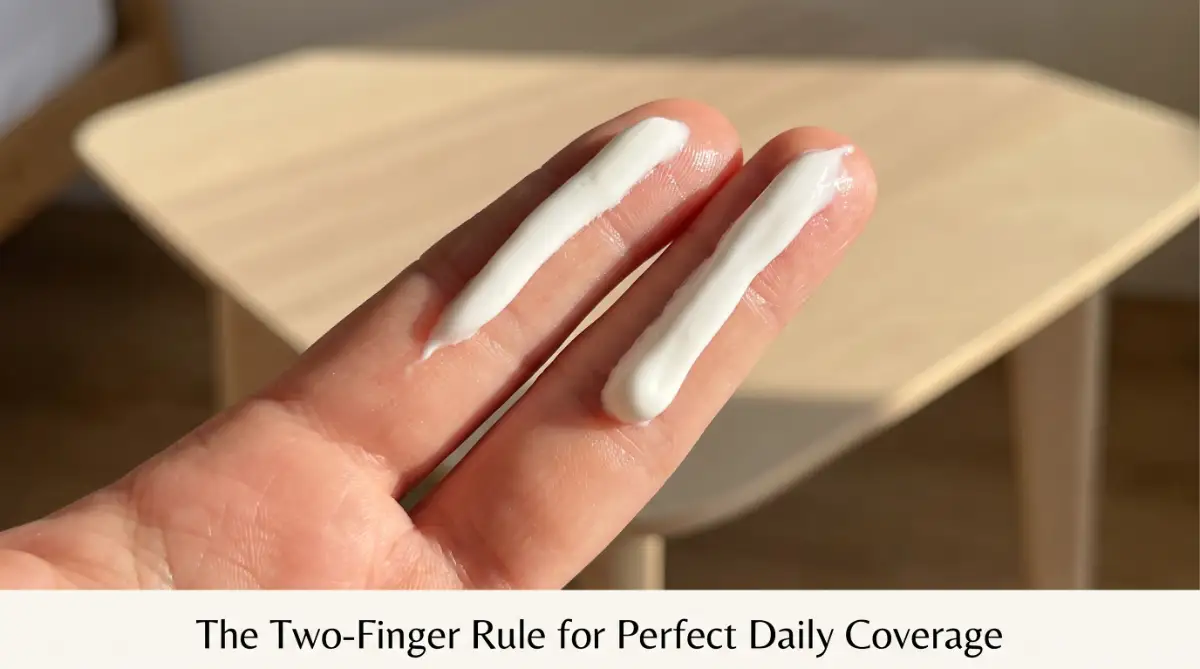
To get the actual protection promised on the label, you need to use the two-finger rule.
Squeeze two consistent lines of sunscreen from the base to the tip of your pointer and middle fingers. This is the exact amount required to fully cover your face and your neck.
If you wait until you are already standing in the hot sun to apply your cream, you are already too late.
Chemical sunscreens need time to bind with your skin cells to form a protective barrier.
Always apply your SPF at least 15 to 20 minutes before you walk out your front door. This gives the formula enough time to dry down and set into a smooth, protective shield.
When we apply sunscreen, we usually focus on our forehead, nose, and cheeks. But the sun does not ignore the rest of your head.
Make sure to apply cream to your ears, the back of your neck, and your eyelids.
Your lips can also get sun damaged and dry, so always use a lip balm with SPF 30 or higher.
Do not rub your sunscreen aggressively between your palms and smear it all over your face. This can cause the cream to bunch up and leave empty spots.
Instead, place small dots of the cream all over your face, neck, and ears.
Slowly spread the dots using gentle, upward strokes, then lightly press the cream into your skin to help it settle evenly.
Continue Reading>>>
Myth vs. Reality: Clearing Up the Confusion
- Myth: I do not need sunscreen if I am staying indoors all day.
- Reality: UVA rays can easily pass through clear glass windows, damaging your skin while you work at your desk or drive.
- Myth: My makeup has SPF 15, so I am fully protected from the sun.
- Reality: You would need to apply ten times the normal amount of foundation to get that level of protection, which is simply not practical.
- Myth: People with darker skin tones do not need to use sunscreen.
- Reality: While darker skin has more natural melanin, it is still vulnerable to UV damage, premature aging, and skin cancer.
How to Reapply Without Ruining Your Day
Getting your morning application right is a great start, but it does not last forever. Sunscreen active ingredients break down under direct sunlight and sweat.
To stay safe, you must reapply your protective layer every two hours when you are outdoors.
If you wear makeup, the thought of rubbing cream over your foundation can feel like a nightmare.
Instead, use a damp makeup sponge to gently pat sunscreen over your existing makeup.
This presses the protective layer onto your skin without smudging your blush or concealer.
Another convenient way to stay protected during a busy day is to use sunscreen sprays or powders.
Keep a small bottle of translucent SPF powder in your bag for quick touch-ups.
Simply dust it over your face to absorb excess oil and renew your sun protection in less than a minute.
The Hidden Cost of Skipping Your Daily Shield
When you skip your daily sunscreen, you are not just risking a temporary sunburn. The long-term effects of UV exposure accumulate slowly over many years.
The sun's deep-penetrating rays break down the natural collagen and elastin fibers in your skin tissue.
These fibers are the building blocks that keep your face looking plump, youthful, and firm.
Without them, your skin begins to sag, and fine lines around your eyes and mouth will appear much earlier than they should.
Have you ever noticed dark brown patches appearing on your cheeks after a long summer?
This is called hyperpigmentation, and it happens when your skin produces too much melanin to protect itself from burning.
These spots can take months, or even years, to fade, even with the help of expensive brightening serums.
Constant sun exposure without protection damages your outer skin barrier.
A damaged barrier makes your skin dry, itchy, and highly reactive to everyday skincare products.
Keeping your face shielded from UV rays is the easiest way to keep your skin calm, balanced, and healthy.
Simple Ways to Make Sunscreen a Daily Habit
It takes time to build a new habit, but consistency is the absolute secret to beautiful skin.
Here are a few easy tricks to make sure you never forget your daily SPF.
- Keep It Visible: Store your sunscreen bottle right next to your toothbrush so you see it every morning.
- Buy Travel Sizes: Keep a small tube of sunscreen in your daily bag, your car, and your desk drawer.
- Find a Formula You Love: If you hate the feel of your sunscreen, you will not use it. Try different gel, cream, or fluid options until you find one that feels like a light moisturizer.
Advanced Strategies for Perfect Sun Protection
To get the absolute best results from your sunscreen, you need to look beyond the basic instructions on the bottle. Advanced sun protection is all about how you layer your products and how you adapt to different environments.
By understanding a few expert secrets, you can make your daily shield perform much better.
Even the best sunscreen cannot block 100 percent of the sun's harmful rays. A small percentage of UV light still gets through and creates free radicals, which are unstable molecules that damage your skin cells.
To stop this damage, apply a Vitamin C serum right before your daily sunscreen. Vitamin C acts like a safety net that catches and neutralizes these free radicals.
This combination of antioxidants and SPF dramatically improves your defense against sun damage. You can read more about how antioxidants boost your protection in this guide by the Skin Cancer Foundation.
The order in which you apply your skincare matters a great deal. If you apply sunscreen in the wrong order, you might block its ability to form a protective film on your face.
Always apply your lightweight serums first, followed by your daily moisturizer. Let your moisturizer sink in completely for at least five minutes before you apply your sunscreen.
This creates a smooth, even surface that allows your sunscreen to bind perfectly to your skin.
You do not need the same level of protection on a rainy winter morning as you do on a bright summer afternoon. Before you plan your day, open your weather app and check the UV Index.
The UV Index is a scale that measures the strength of skin-damaging ultraviolet radiation at a specific time and place.
If the index is 3 or higher, your skin can damage easily without proper protection. To learn more about how this scale is calculated, check out the official World Health Organization UV Index database.
Many people view sunscreen as something they only need to use when they go to the beach. However, daily exposure to small amounts of light adds up over a lifetime.
Protecting your skin is a long-term commitment that requires daily action. It is very similar to how you manage other important parts of your life, like your budget.
Just like you protect your future comfort when you learn how to build a bulletproof emergency fund fast, applying your daily SPF protects your future skin health.
Both habits require small, daily choices that pay off massively down the road.

Hidden Traps: The Skincare Blunders That Damage Your Skin
Even with the best intentions, it is easy to fall into habits that quietly ruin your sun protection.
Let us look at the most common traps that might be leaving your skin completely exposed to danger.
Have you ever mixed your sunscreen directly into your liquid foundation or face cream to save time in the morning?
This is a major mistake that ruins the chemistry of your sun protection.
When you mix sunscreen with other lotions, you dilute the active ingredients and create empty spots in your protective barrier. Always apply your sunscreen as a single, separate layer to keep its protective power fully intact.
Sunscreen does not last forever, even if the bottle looks completely full and clean. Over time, the active chemicals that block UV rays break down and lose their strength.
Using an expired product will leave your skin completely unprotected, leading to sudden burns and dark spots.
Always check the expiration date on the crimped edge of the tube or the bottom of the bottle. If the texture of the cream has changed, or if it smells sour, throw it away immediately.
Many people treat their face with incredible care but stop applying products as soon as they hit their jawline.
Your neck and upper chest have very thin skin that is highly vulnerable to rapid aging and sun damage.
Skipping these areas will eventually lead to an uneven skin tone where your face looks youthful but your neck shows deep lines. Treat your neck and chest as an extension of your face and apply the exact same amount of protection there.
What happens if you forget to apply sunscreen or miss a spot during a busy day outside? The sun damage can start to build up quickly, causing redness and deep irritation.
Missing a day of protection is a setback, but you can always take active steps to calm your skin afterward.
This is similar to managing your personal finances when things do not go as planned. Just as you must react quickly when you learn what happens if you miss a personal loan emi payment and how to fix it, you must act fast to soothe your sun-exposed skin with gentle, hydrating ingredients like aloe vera and ceramides.
Sometimes, we get so busy that we make small mistakes without realizing how much they set us back.
In skincare, a tiny mistake like rubbing your face with a rough towel can wipe away your entire layer of sunscreen.
This is very similar to how a tiny error on an application form can ruin your plans, as shown in the ultimate guide to getting approved personal loan mistakes you must avoid.
Paying close attention to the small details of your daily routine will save you from major frustrations later on.
Your Daily Action Plan for Radiant Skin
Trust me, turning sun protection into a mindless daily habit took some trial and error, but seeing my skin finally stay clear and calm makes every second worth it. Let's ditch the old excuses starting today and give our skin the real, everyday shield it has been begging for.
Protecting your skin does not have to feel like a difficult chore.
With a few smart adjustments, you can make sun safety a natural and enjoyable part of your morning routine.
If your current skincare routine feels too complicated, you are much more likely to skip steps.
When your bathroom counter is cluttered with ten different bottles, you might feel too overwhelmed to apply your sunscreen.
Try to simplify your steps so that you can focus on what really matters.
This is a lot like organizing your monthly expenses; learning how to consolidate multiple debts without hurting your credit score helps you clear your mind, and simplifying your skincare steps does the exact same thing for your daily peace of mind.
To keep your skin looking fresh and healthy, follow this simple daily action plan.
- Check the Weather: Look at the UV Index before you leave your house.
- Measure Your Amount: Use the two-finger rule every single morning.
- Wait to Dry: Let your sunscreen sit for fifteen minutes before applying makeup or walking outside.
- Keep a Spare: Put a travel-sized sunscreen tube in your car or workspace for emergency use.
Your skin is your body's largest organ, and it works incredibly hard to protect you from the outside world.
By applying your sunscreen properly every day, you are giving your skin the help and support it needs to stay strong.
Do not worry if you have made mistakes with your sun protection in the past.
Start fresh today, keep your routine simple, and enjoy the confidence that comes with having happy, healthy, and fully protected skin.

Disclaimer
This article is for informational and educational purposes only. The content is not intended to be a substitute for professional medical advice, diagnosis, or treatment.
Always seek the advice of your dermatologist, physician, or other qualified health provider with any questions you may have regarding a medical condition or skin concern.


