California Car Accident Checklist: Immediate Steps to Protect Your Rights
Picture this scene. You are driving down Interstate 5 near Los Angeles after a long day at work. Traffic moves in rhythm, and you are thinking about dinner.
Out of nowhere, a sharp screech pierces the air. You hear the deafening crunch of metal hitting metal, and your vehicle lurches forward violently.
In an instant, your peaceful drive turns into complete chaos. Your heart beats uncontrollably against your chest, and your hands begin to shake on the wheel.
Smokey haze fills the air from deployed airbags, and confusion floods your mind. Questions race through your head all at once. Is everyone okay? Who caused this? What should I do first?
A few years ago, I was rear-ended on the freeway during evening rush hour, and my world turned upside down in a fraction of a second. I made the painful mistake of panicking and accepting a verbal promise from the other driver, which ended up costing me thousands of dollars out of pocket. That scary experience taught me how tricky California auto laws can be, and it is the exact reason I wrote this guide—so you never have to go through the same nightmare I did.
This jarring confusion happens to thousands of drivers across California every single week. In those overwhelming moments, fear can easily cloud your judgment.
Making one small misstep on the side of the road can damage your health and destroy your insurance claim. Knowing the exact sequence of actions to take gives you your power back during a scary event.
Immediate Safety Actions to Take on the Road
Your physical safety takes absolute priority over everything else after a collision occurs. Never focus on fault or vehicle repairs before securing the area.
First, check yourself and your passengers for any immediate visible injuries or severe pain. If anyone feels dizzy or suffers from back or neck pain, try to keep them completely still.
Move your vehicle to a safe location if it can still drive safely. Pull onto the shoulder, clear of active traffic lanes, to prevent a dangerous chain-reaction accident.
Turn on your hazard lights right away to alert oncoming drivers. If you have reflective flares or safety triangles in your trunk, set them up behind your car.
If the collision turns out to be severe, leave the vehicles where they rest if moving them causes more safety risks. Exit the vehicle carefully only when traffic permits, and stand behind safe highway barriers.
Never leave the scene of any vehicle crash in California. Driving away can turn a simple accident into a serious hit-and-run criminal charge under state law.
How to Call the Police and Exchange Details Properly
Contacting local law enforcement is a step you should never skip, even for what seems like a simple fender bender. Call 911 immediately so emergency personnel and officers arrive quickly.
When officers arrive, stay completely calm and state facts without guessing. Explain what happened plainly without making assumptions or placing blame on anyone.
Request the law enforcement officer to create an official collision report. Note down the officer's full name, badge number, and the official police report number for your records.
While waiting for the police, collect basic information from all other drivers involved in the crash. Keep conversation short and focused purely on information exchange.
Collect these details carefully from every involved party:
- Full name, phone number, and residential address.
- Driver's license number and state of issue.
- Car insurance company name and policy number.
- License plate numbers and vehicle identification numbers (VIN).
- Vehicle make, model, color, and year.
Pro Tip: Take a picture of the other driver's driver's license and insurance card using your phone camera. This saves time and prevents writing errors.
Essential Evidence to Collect Right After the Crash
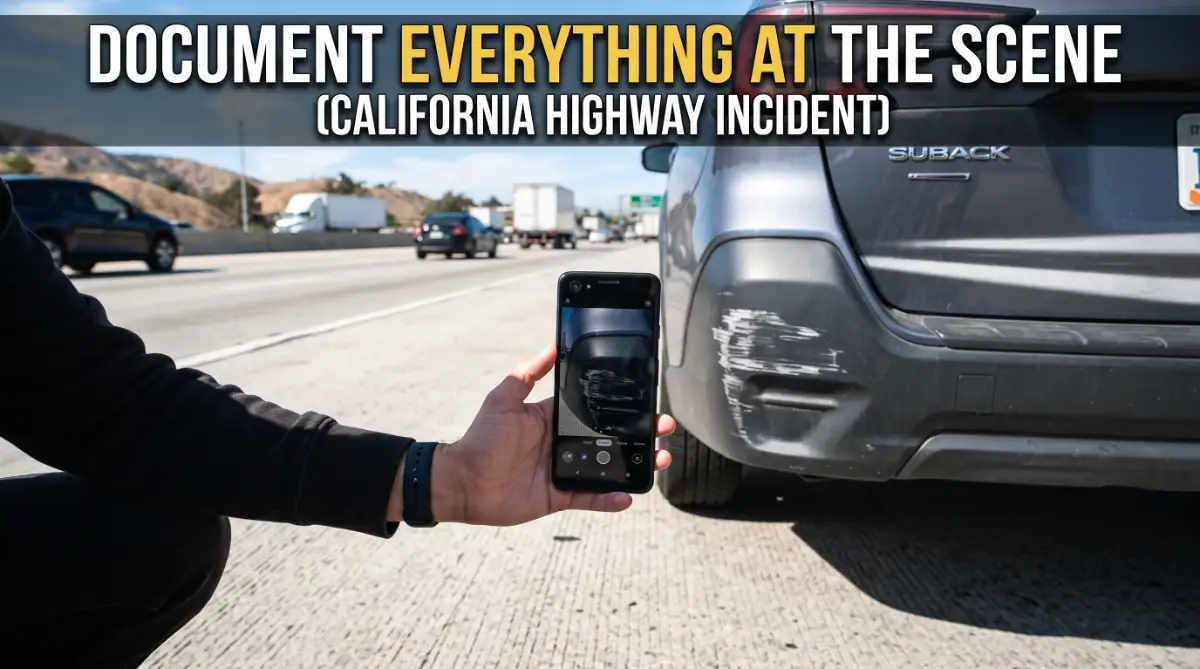
Your phone camera is your strongest tool in the minutes following an accident. Memories fade quickly, but clear physical photos provide undeniable proof for insurance carriers.
Start by taking wide-angle photos of the entire accident scene. Include road condition signs, weather visibility, traffic lights, and street markings nearby.
Next, step closer and take detailed pictures of all vehicles involved. Shoot close-up photos of all vehicle body damage, shattered glass, broken lights, and scraped paint.
Look around for tire skid marks on the road surface, shattered car parts, or damaged road guardrails. Photograph these details from multiple angles before traffic clears them away.
Check if any bystanders saw the collision happen. Ask for their names and contact phone numbers before they walk away from the area.
Neutral witness accounts hold immense weight when insurance companies evaluate who caused the crash. A quick two-minute conversation with a witness can save your claim later.
California Laws You Need to Know
Watch this quick, easy-to-follow video breakdown that clearly explains how California traffic regulations and fault rules work after a road collision. Spending two minutes watching this clip will help you understand your legal rights before you read the detailed steps below!
California operates under legal rules that heavily influence how accident claims get processed. Understanding these rules protects you against unfair insurance denials.
First, California uses a system called Pure Comparative Fault. This means more than one driver can share partial responsibility for a crash.
For example, if a judge finds you 20% responsible for a crash, your final compensation drops by 20%. You can still recover 80% of your total financial losses.
Second, you must report accidents to the California Department of Motor Vehicles (DMV). You must submit a specific form called the DMV SR-1 Form within 10 days if:
- Any person involved suffered bodily injury, no matter how minor.
- Any person involved was killed in the accident.
- Total property damage exceeds $1,000 for any vehicle involved.
Failing to submit this mandatory SR-1 form can result in the suspension of your California driver's license, regardless of who caused the accident.
What to Say vs. What NEVER to Say
Words matter immensely after an auto crash. Insurance claims adjusters record phone conversations and scan statements for any hint of admitted guilt.
When an insurance adjuster called me two days after my collision, I casually said I was "doing okay" just to be polite. That single innocent phrase was later used to fight my medical bills when my neck injury flared up the following morning. My hard-learned lesson for you is simple: never apologize or estimate your health status over the phone until a medical doctor gives you a full checkup.
Even simple everyday politeness can backfire dramatically during an insurance investigation.
Debunking Common California Crash Myths
- Myth: You do not need to report the crash to the DMV if the police came to the scene.
- Reality: The police report does not substitute for your individual duty to file an SR-1 form with the DMV. You must file it yourself.
- Myth: You must give a recorded statement to the other driver's insurance representative immediately.
- Reality: You have zero legal obligation to provide a recorded statement to the opposing insurer without speaking to legal counsel first.
- Myth: If you feel no immediate pain, you do not need to see a medical professional.
- Reality: Adrenaline masks severe internal damage, soft tissue tears, and concussions. Symptoms often appear 24 to 48 hours later.
Expert Insight: Never sign any settlement documents or accept quick check payments from an insurance company on the spot. Early offers almost always undercut your true long-term medical costs.
Seeking Medical Care and Managing Your Recovery
Always get checked by a doctor or visit an urgent care center immediately after leaving the crash scene. Prompt medical evaluation proves that your injuries came directly from the accident.
Tell the attending physician every detail about how the collision occurred and list every area of discomfort. Do not downplay minor aches, stiffness, or headache symptoms.
Follow all medical instructions and treatment plans carefully. Attend every physical therapy session and take all prescribed medicines without skipping days.
If you skip appointments, insurance adjusters will argue that your injuries were not serious or were caused by something else later.
Keep an organized folder containing every medical record, emergency visit bill, diagnostic scan result, and prescription receipt.
Create a personal daily recovery log in a notebook. Write down your pain levels, missed work hours, sleeping troubles, and emotional stress experienced each day.
This written daily documentation serves as compelling proof when requesting fair compensation for pain and suffering.
Navigating Insurance Adjusters Without Losing Compensation
Shortly after filing an insurance claim, an insurance adjuster will call you. Understand that their main business goal is to minimize the amount of money their company pays out.
Remain calm, polite, and brief during every conversation with an adjuster. Give only verified facts like time, date, location, and contact details.
Do not guess about vehicle speeds, exact stopping distances, or complex injury details. If you do not know an exact answer, simply say, "I am not sure at this moment."
Never discuss pre-existing medical conditions or bring up old injuries during these initial phone calls.
Refuse requests for recorded phone statements until you have reviewed your rights thoroughly.
Keep a detailed log of every phone call, email, and paper letter received from insurance representatives. Note the date, time, caller name, and what was discussed during each exchange.
When to Consult an Experienced California Personal Injury Attorney
Navigating medical expenses, property damages, and aggressive insurance representatives can feel like a heavy burden when recovering from a crash.
If your accident involved severe physical injuries, long-term care needs, disputed liability, or an uninsured driver, seeking legal guidance is wise.
A qualified local personal injury attorney handles tough communications with insurance agents on your behalf. They investigate the crash scene, consult accident reconstruction experts, and calculate true future financial costs.
Most personal injury legal firms operate on a contingency fee basis. This means you pay no upfront legal fees unless they recover money for your claim.
Getting professional assistance allows you to focus entirely on physical healing while an expert handles the legal complexities.
Take deep breaths, handle each required step one by one, and prioritize your well-being above everything else. With the right steps, you can move past a California accident with confidence and peace of mind.
Strategic Tactics to Protect Your Long-Term Claims and Financial Future
Handling the immediate aftermath of a crash is only the beginning of your recovery journey. Once the initial shock wears off, you must protect your long-term financial stability with advanced tactics.
Insurance companies count on injured drivers making small mistakes over the coming weeks. By taking proactive measures, you can safeguard your financial health and ensure your claim receives full evaluation.
Unlocking Your Right to a Diminished Value Claim
Many drivers do not realize that even after a repair shop fixes their vehicle to perfection, the car loses market value. A vehicle with an accident history on its record automatically worth less to future buyers.
In California, you have the legal right to file a Diminished Value Claim against the fault driver's insurance provider. This claim compensates you for the lost resale value of your automobile.
To secure this compensation, hire an independent certified vehicle appraiser to evaluate your repaired car. They will produce an official appraisal report showing the exact loss in market value.
Submit this appraisal report along with photos of the original damage to the insurance adjuster. Standing firm on diminished value can recover thousands of dollars that most drivers unknowingly leave behind.
Navigating Health Insurance Subrogation and Medical Liens
When your medical providers bill your private health insurance or Medi-Cal for crash-related treatments, those insurers pay initial bills. However, they hold a legal right called subrogation to get repaid from your final settlement.
Understanding subrogation prevents sudden financial surprises when your case resolves. If you receive a settlement check, your health insurer may demand immediate repayment for the care they covered.
You can often negotiate these medical liens down significantly before finalizing any legal settlement. Medical providers and health plans often accept reduced payments if you explain your legal costs.
Always request an itemized billing ledger from every hospital, physical therapy clinic, and doctor office. Review these ledgers carefully to spot duplicate charges, incorrect billing codes, or unperformed services.
For official guidance on California highway safety standards and driver responsibilities, review the California Department of Motor Vehicles official resources.
Protecting Your Personal Privacy in the Digital Age
In today's connected world, insurance investigators routinely monitor claimant social media profiles. They look for any photo, comment, or check-in that might contradict your physical injury claims.
A simple photo of you standing at a family birthday party can be twisted by an adjuster. They may claim your back injury is fake because you appeared happy in a picture.
Set all your social media accounts to strict private modes immediately following a road accident. Better yet, step away from posting online entirely while your claim remains open.
Instruct your close family members and friends not to post photos of you or tag you in updates. Preserving your digital privacy prevents insurance companies from taking your words or actions out of context.

Costly Missteps That Threaten Your Physical and Financial Recovery
When you are stressed after a vehicle collision, making mistakes is easy. Unfortunately, simple errors in judgment can completely destroy an otherwise strong insurance claim.
Knowing these common traps allows you to avoid them and protect your family's future peace of mind.
Relying on Handshake Agreements at the Crash Scene
Sometimes, the driver who caused the collision will beg you not to involve police or insurance companies. They might offer to pay you cash directly out of pocket for your vehicle repairs.
Accepting a verbal agreement or taking a small cash payment on the spot is a massive trap. Repair estimates almost always end up costing far more than initial visual inspections suggest.
Hidden structural damage to the car frame or electronics can cost thousands of dollars to fix. Once you walk away from the scene without police doc