10-Minute Exercises to Naturally Induce Labor at Home
You are staring at the calendar again. You have washed the baby clothes, set up the crib, and packed your hospital bag three different times.
Your back aches, your feet are swollen, and sleeping through the night feels like a distant memory. Every single time you feel a tiny cramp, you hold your breath and wonder, "Is this it? Is it finally time?"
I know exactly how exhausting this waiting game can be. The final weeks of pregnancy often feel longer than the previous months combined.
I remember sitting on my living room floor at 39 weeks, absolutely exhausted and crying out of pure frustration. My back felt like it was splitting in two, and every single time my phone buzzed with a text asking "Is baby here yet?", I wanted to throw it against the wall.
I felt so heavy and desperate to finally meet my little one, but my body just seemed stuck in waiting mode. That is exactly when I started looking for simple, natural ways to gently nudge my body into action without exhausting myself before the real work even began.
Your mind races with worry. You are getting texts from family members asking, "Any news yet?" every single morning. The pressure starts to build, and that mental peace you tried so hard to maintain suddenly slips away.
You just want a safe, naturalbirth. You want to avoid medical interventions if possible, and you are desperately looking for safe ways to start labor.
It feels completely out of your control. You might even feel a little trapped in your own body right now.
But I have some good news for you. You do not have to just sit on the couch and wait.
By using specific labor induction exercises, you can actively help your body get ready. You can take back a little bit of control, ease your physical pain, and gently nudge your baby into the right position.
Let me show you exactly how a simple, daily routine can change everything for you.

Getting Your Body Ready: The Journey So Far
Before we jump into the 10-minute routines, let us take a moment to look back at how far you have come. Your body has already done incredible work.
Think back to those early days. You likely battled morning sickness and spent hours searching for Nausea relief foods.
You completely overhauled your lifestyle. You focused heavily on your First trimester diet and researched every Pregnancy nutrition guide you could find.
You mastered the art of Managing pregnancy nausea while trying to maintain Healthy eating for moms. You used Prenatal dietary hacks to make sure your baby got the right vitamins, even when you did not feel like eating labor induction exercises naturally induce labor at home safe ways to start labor preparing for natural birth third trimester workouts
You put so much effort into Pregnancy meal planning and prioritizing Women health. Now, as you approach the finish line, your focus shifts from diet to movement.
Just like those Health tips helped you survive the early days, physical movement will help you prepare for a naturalbirth. You are still the same strong mother; you just need a new set of tools.
Why Movement Matters Right Now
Your baby needs to drop deeper into your pelvis to trigger cervical dilation. Sitting for long hours actually works against this process.
When you sit on soft couches, your pelvis tilts backward. This can cause your baby to move into a less optimal position.
By practicing safe ways to start labor through targeted movement, you open up your pelvis. You create space for your baby’s head to apply pressure on your cervix.
This gentle, consistent pressure is what releases oxytocin. Oxytocin is the hormone responsible for starting contractions.
You do not need to run a marathon to make this happen. Just 10 minutes a day can naturally induce labor at home safely.
The 10-Minute Labor Activation Routine
If you are more of a visual learner, take a quick break and watch this video below! It perfectly demonstrates how to perform these gentle stretches safely, so you can see exactly how to support your body before we break down each movement step-by-step.
You do not need fancy equipment or a gym membership for this. You just need a little floor space, maybe a birthing ball, and 10 spare minutes.
I recommend doing this short routine twice a day. Morning and evening work perfectly.
Listen to your body. If anything hurts, stop immediately and rest. We want to naturally induce labor at home, not cause you unnecessary pain.
Move 1: The Deep Supported Squat (2 Minutes)
Squatting is one of the most powerful labor induction exercises known to women. It can open your pelvic outlet by up to 28 percent.
This extra space allows your baby to descend easily. It is a cornerstone of naturalinduction techniques.
How to do it safely:
- Stand facing a sturdy chair, the edge of your bed, or your partner.
- Keep your feet wider than your hips, with your toes pointing slightly outward.
- Hold onto your support and slowly lower your hips toward the floor.
- Keep your heels flat on the ground. If they lift up, widen your stance.
- Hold the bottom of the squat for three deep breaths, then slowly stand back up.
Repeat this slowly for two minutes. Focus on relaxing your pelvic floor as you breathe out.
Expert Insight: Do not bounce while squatting. Bouncing can strain your knees and pelvic joints, which are currently very loose due to the hormone relaxin.
Move 2: The Birthing Ball Pelvic Tilt (3 Minutes)
Here is a quick lesson I learned the hard way: do not just bounce wildly on the birthing ball while watching TV. I used to bounce so aggressively that I ended up straining my lower back, which only added to my late-pregnancy misery. The real magic happens when you slow down and intentionally roll your hips in wide, slow circles—it actually helps the baby’s head engage much better than bouncing does.
If you do not have a birthing ball yet, I highly recommend borrowing or buying one. It is a fantastic tool for preparing for natural birth.
Using a stability ball encourages active sitting. It keeps your pelvis tilted forward, which is exactly what we want third trimester workouts active labor prep Pregnancy Yoga naturally induce labor at home naturalbirth
How to do it safely:
- Sit right in the center of the ball with your feet flat on the floor.
- Your knees should be at a 90-degree angle or slightly lower than your hips.
- Slowly rock your hips forward and backward.
- Next, roll your hips in large, slow circles, like you are drawing an "O" with your tailbone.
- Do 10 circles to the left, then switch and do 10 circles to the right.
This simple movement helps wiggle the baby down into the birth canal. It is also a staple in Pregnancy Yoga for relieving lower back pain.
Move 3: The Curb Walk or Asymmetrical Step (3 Minutes)
You might have heard of curb walking from other moms. It is highly effective for a naturalinduction.
When you walk with one foot higher than the other, your pelvis shifts unevenly. This asymmetrical movement helps adjust a baby that might be stuck in a slightly awkward position.
How to do it safely:
- If you are outside, walk safely along a quiet street with one foot on the sidewalk and one on the road.
- If you prefer to inducelaborathome without going outside, use a small step stool or a thick book.
- Step up with your right foot, then bring your left foot up.
- Step down backward.
- Repeat this process, leading with alternating feet.
Keep your balance in check. Hold onto a wall or a railing if you feel unsteady.
This is one of the most highly recommended third trimester workouts because it actively engages gravity.
Move 4: The Butterfly Stretch (2 Minutes)
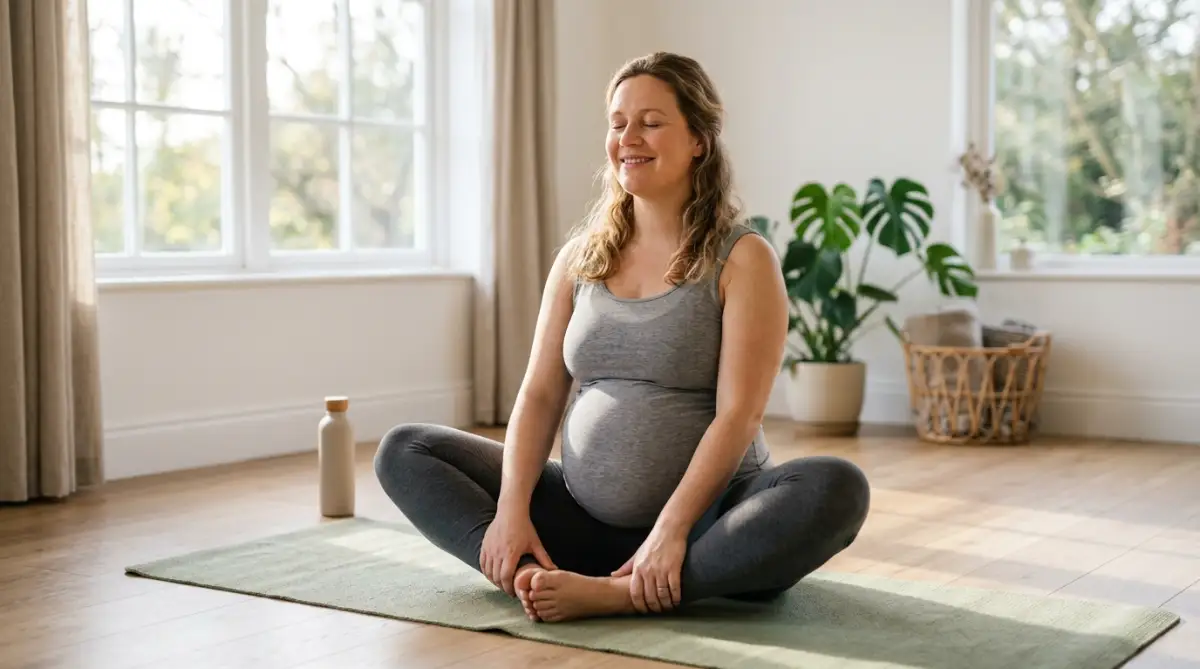
We will finish the routine on the floor. This is a cooling, relaxing stretch that heavily focuses on your inner thighs and pelvic floor.
Tight pelvic floor muscles can actually delay labor. Relaxing them is a huge part of preparing for natural birth.
How to do it safely:
- Sit on a comfortable yoga mat or carpet.
- Bring the soles of your feet together in front of you, letting your knees drop to the sides.
- Keep your back straight. You can sit against a wall for extra support.
- Gently hold your ankles and take deep, slow breaths.
- Do not push your knees down with your hands. Let gravity do the work.
As you sit here, close your eyes. Picture your body opening up and welcoming your baby.
This mental visualization is a powerful part of Pregnancy Yoga. It helps calm your nervous system.
Myth vs Reality: What Actually Works?
When you are desperately looking for safe ways to start labor, you will hear a lot of crazy advice. Let us clear up some common confusion right now.
As you can see, physical movement and targeted stretches remain the most reliable methods. They do not carry the risks that drinking strange concoctions do.
Supporting Your Body From the Inside Out
Doing the physical exercises is just one piece of the puzzle. You also need to support your body nutritionally to naturally induce labor at home.
Remember all the effort you put into your First trimester diet? You need that same dedication right now preparing for natural birth naturalinduction Women health labor induction exercises inducelaborathome
You relied on a Pregnancy nutrition guide to grow your baby. Now you need to fuel your body for the physical marathon of childbirth.
Hydration is Your Best Friend
Your uterus is a giant muscle. Like any muscle in your body, it needs water to function properly.
If you are dehydrated, your uterus can cramp improperly. This leads to painful, unproductive contractions known as Braxton Hicks.
Aim for at least 80 to 100 ounces of water a day. If plain water makes you feel sick, revisit your old Nausea relief foods list.
Add a splash of lemon or cucumber to your water. Staying hydrated is one of the simplest Pregnancy health tips you can follow.
Keep Your Energy Levels High
Labor requires a massive amount of calories. You cannot go into it running on an empty tank.
Even if you feel heavy and sluggish, stick to your Pregnancy meal planning. Focus on complex carbohydrates for lasting energy.
Eat small meals like oatmeal, bananas, and whole-grain toast. These are great staples of Healthy eating for moms.
If late-pregnancy heartburn brings back memories of your morning sickness, eat smaller portions more frequently. Managing pregnancy nausea at the end of your term requires the same Prenatal dietary hacks you used months ago.
When to Stop the Exercises and Call Your Doctor
While we want to inducelaborathome, safety is always our main priority. You must pay attention to what your body is telling you.
These third trimester workouts are designed to be gentle. They should never cause sharp or sudden pain.
Stop your routine and call your provider immediately if you notice:
- Your water breaks: You might feel a large gush or a slow, continuous trickle of fluid.
- Bleeding: A tiny bit of pinkish discharge (the bloody show) is normal. Bright red blood is not.
- Decreased baby movement: If you have not felt your baby move normally, do not wait. Go get checked.
- Dizziness or blurry vision: These can be signs of high blood pressure, which is very dangerous.
Always remember that these Health tips are meant for low-risk pregnancies. If you have complications like placenta previa or preeclampsia, your doctor might put you on strict bed rest.
Never try a naturalinduction without getting the green light from your healthcare team first. Women health requires a team effort between you and your medical provider.
The Power of the Mind-Body Connection
We have talked a lot about physical steps. Now we need to talk about your brain.
Your mind plays a massive role in starting labor. If you are stressed, scared, or anxious, your body releases adrenaline.
Adrenaline is the "fight or flight" hormone. It actively blocks oxytocin, which is the "love and labor" hormone.
This means that if you are constantly worrying about when labor will start, you might actually be delaying it. Your body senses danger and decides it is not safe to have a baby right now.
How to Tell Your Body It Is Safe
You need to actively calm your nervous system. This is just as important as your daily labor induction exercises.
Turn down the lights in your house as evening approaches. Bright artificial lights can mess with your natural hormone production.
Play soft, relaxing music. Take a warm (not hot) bath to soothe your aching muscles.
Practice deep belly breathing. Breathe in deeply through your nose, letting your belly expand like a balloon.
Exhale slowly through your mouth with a soft sighing sound. This type of breathing is heavily taught in Pregnancy Yoga because it forces the pelvic floor to let go of tension.
Do not answer stressful text messages. Put your phone on "Do Not Disturb" mode. Protect your peace fiercely as you focus on preparing for natural birth.
Getting Your Partner Involved
You do not have to do this alone. Your partner can be a huge help when you are trying to naturally induce labor at home.
Having support makes you feel loved and safe. As we just learned, feeling safe boosts oxytocin levels significantly.
Partner-Assisted Stretches
During your deep squats, have your partner hold your hands to give you better balance. This allows you to sink deeper into the stretch without fear of falling.
They can also massage your lower back while you bounce on the birthing ball. Gentle counter-pressure on the hips feels amazing during these third trimester workouts.
Emotional Support
Ask your partner to be the "gatekeeper" for your phone. Let them handle the daily questions from family and friends.
They can simply say, "Mom and baby are doing great. We will let you know when things happen!"
This takes the mental load off your shoulders. It allows you to focus purely on your naturalbirth goals and your daily exercises.
Real-Life Examples: How Movement Changes Things
Sometimes, hearing how this works for others can give you the motivation to start. Let us look at a practical scenario.
Imagine a mother who works a desk job. She sits for eight hours a day, leaning back in her office chair.
Her baby is comfortably resting against her spine (a posterior position). This position often leads to painful "back labor."
She decides to implement these safe ways to start labor into her routine. She replaces her office chair with a birthing ball for two hours a day.
Every evening, she spends 10 minutes doing curb walking and deep squats. Within just a few days, gravity and movement do their job.
Her baby rotates forward, resting heavily on her cervix. The pressure triggers steady contractions, and she goes into a smooth, active labor.
This is not magic. It is simple human anatomy. Moving your body changes the space inside your pelvis.
Reviewing Your Full Action Plan
You are at the very end of your journey. You have survived the exhaustion of the first trimester, the endless Pregnancy meal planning, and the physical weight of the third trimester.
Now, you have a solid, actionable plan. Let us review exactly what you need to do starting today.
- Hydrate and Fuel Up: Drink plenty of water and eat energy-boosting foods. Use your trusted Pregnancy nutrition guide.
- Move Twice a Day: Dedicate 10 minutes in the morning and 10 minutes in the evening to your routine.
- Squat and Bounce: Focus on deep squats and using your birthing ball to open the pelvis.
- Walk Asymmetrically: Use the curb walking method to help shift a stubborn baby.
- Relax and Breathe: Do your butterfly stretches while practicing deep, calming breaths.
- Block Out Stress: Ignore annoying texts, dim the lights, and create a peaceful environment in your home.
By following these Pregnancy health tips, you are doing everything in your power to help your body.
Remember, babies come when they are truly ready. These exercises will not force a baby out before their time.
What they will do is ensure your body is perfectly primed, open, and ready the exact second your baby decides it is time to meet you.
Stay consistent with your movements. Trust the process, trust your body, and breathe. You are about to do something amazing.
Next-Level Strategies to Encourage a Smooth Delivery
We have covered the basic movements, but there is so much more you can do to prepare your body. The goal here is not just to trigger contractions but to make sure those contractions are effective.
Many women try to naturally induce labor at home without fully understanding body mechanics. If your baby is not in the best position, those early contractions might just fizzle out.
To prevent that, we need to focus on advanced pelvic opening techniques. These strategies require a bit more mindfulness but are incredibly powerful for a naturalbirth.
The Miles Circuit: A Proven Method for Positioning
Have you ever heard of the Miles Circuit? It is a favorite among doulas and midwives for active labor prep.
The Miles Circuit is a specific series of positions designed to move your baby into the optimal spot. When the baby's head is directly over your cervix, labor induction exercises become much more effective.
Position 1: Open-Knee Chest (30 Minutes)
You start on your hands and knees. Drop your chest directly to the floor or onto a thick pillow.
Keep your knees wide apart and your hips high in the air. This position uses gravity to pull the baby slightly out of your pelvis, giving them room to rotate.
Position 2: The Exaggerated Side-Lying Stretch (30 Minutes)
Lie on your left side. Pull your top knee up as high as it will go, resting it on a peanut ball or a stack of firm pillows.
Your bottom leg should remain perfectly straight. Roll your chest forward so your belly is resting softly on the bed.
This creates a massive amount of space in the middle of your pelvis. If you struggle with lower back pain, you might find this stretch incredibly relieving.
Position 3: Upright Movement (30 Minutes)
After creating space, you need to use gravity again. Spend the next 30 minutes doing deep squats or bouncing on your birthing ball.
You can also use this time for curb walking. The sequence of resting, rotating, and moving is a masterclass in preparing for natural birth.
The Rebozo Sifting Technique
This is a traditional Mexican midwifery technique that has gained massive popularity worldwide. It requires a long, woven cloth (a Rebozo) and a willing partner.
The goal is to gently jiggle your belly, helping to relax the heavy ligaments supporting your uterus. Tight ligaments can act like a tight seatbelt, preventing the baby from moving down.
How it works safely:
You get on your hands and knees on a soft surface. Your partner wraps the long cloth under your belly, holding the two ends above your back.
They slowly and gently shift their weight from side to side, creating a soft, rhythmic jiggle in your belly. It should feel like a very gentle, relaxing massage.
According to the American College of Nurse-Midwives, techniques that promote relaxation can significantly improve maternal comfort. It is not meant to be rough or aggressive in any way.
Combining Acupressure With Movement
Did you know there are specific pressure points on your body linked to your uterus? Acupressure is an ancient practice that pairs perfectly with modern third trimester workouts.
While you are resting between squats, have your partner massage the webbed area between your thumb and pointer finger (known as LI4 or Hegu). Applying firm pressure here is known to encourage downward energy and contractions.
Another highly effective point is located about four finger-widths above your inner ankle bone (known as SP6). Massaging this area can help ripen the cervix.
Combine these pressure points with your deep breathing routines. The physical touch combined with mental focus is a cornerstone of effective Pregnancy Yoga.
Hidden Traps: What Derailed My Best Intentions?
When you are desperately trying to naturally induce labor at home, it is very easy to fall into a few common traps. I see well-meaning mothers make these mistakes all the time.
These pitfalls do not just waste your time; they can actively delay your progress. Worse, they can leave you exhausted before the real work even begins.
The Exhaustion Trap: Doing Too Much, Too Fast
You watch a video online about a mom who walked five miles and went into labor that night. Suddenly, you think you need to do the same thing.
You strap on your shoes and force yourself to walk for two hours, ignoring your aching back and swollen feet. What happens next?
You wake up the next day completely drained. Your muscles scream in pain, and your energy levels are entirely depleted.
If labor actually started right then, you would have zero energy left to push. Exhaustion is the enemy of a naturalbirth.
Your body is incredibly smart. If it senses that you are physically depleted, it will delay labor. It knows you need strength to deliver your baby safely.
Stick to the gentle 10-minute labor induction exercises we discussed earlier. Save your heavy lifting and marathon running for after you recover from childbirth.
Ignoring Your Emotional State
You are bouncing on your birthing ball, but your mind is racing. You are stressing about your maternity leave, answering work emails, and worrying about the hospital bill.
You are doing the physical work, but your brain is blocking the progress. As we discussed earlier, stress hormones actively fight against oxytocin.
Trying to inducelaborathome while you are in a state of high anxiety is like driving with the parking brake on. You might move a little, but you are causing massive friction.
If you find yourself constantly stressed, stop the physical exercises. Spend that 10 minutes practicing deep breathing or taking a warm bath instead.
Your mental relaxation is a highly critical part of Women health during late pregnancy.
Dehydration: The Silent Saboteur
Many mothers restrict their water intake in the third trimester. Why? Because they are tired of running to the bathroom every twenty minutes.
While the frequent bathroom trips are frustrating, dehydration is incredibly dangerous right now. A dry, dehydrated uterus is an unhappy, crampy uterus.
Dehydration often leads to painful false labor contractions. These cramps hurt just as much as real contractions, but they do not actually dilate your cervix.
You end up suffering through hours of pain for absolutely no progress. Drinking enough water is a non-negotiable part of your Health tips routine.
If you need a refresher on why this matters so much, review how proper hydration supports healthy amniotic fluid levels during pregnancy. Water is literally the cushion keeping your baby safe.
Relying on Outdated or Dangerous Advice
I mentioned this earlier, but it bears repeating. Desperation can make us try things we normally would not.
Drinking castor oil is a massive mistake. It does not naturally induce labor at home; it causes severe gastrointestinal distress.
Having violent diarrhea while trying to manage contractions is a miserable experience. Furthermore, the violent cramping in your bowels can distress your baby, leading to a dangerous heart rate drop.
Stick to safe, proven methods like gentle movement and proper Pregnancy meal planning. The risks of untested home remedies are simply too high.
If you are concerned about your diet at this stage, focus on maintaining balanced blood sugar. You can review how to prevent gestational diabetes with an easy meal plan to ensure your final weeks remain healthy.
Your Action Plan for the Days Ahead
You have learned the physical exercises, the advanced positioning secrets, and the mental blocks to avoid. Now, it is time to put all of this into practice.
You do not need to do every single thing on this list every single day. That would be overwhelming, and overwhelm leads to stress.
Instead, pick two or three things that feel good to your body today. If you feel energetic, try the curb walking.
If your back is aching, spend 30 minutes in the exaggerated side-lying position from the Miles Circuit. Listen to your body, because your body knows exactly what it needs to do.
Here is a quick checklist to keep you focused:
- Move intentionally: Do your deep squats and birthing ball bounces in short, 10-minute bursts.
- Protect your peace: Dim the lights, play soft music, and actively practice deep breathing to boost oxytocin.
- Stay hydrated: Keep a large water bottle next to you at all times. Drink even when you do not feel thirsty.
- Rest deeply: Take naps during the day. Go to bed early. Store up all the energy you can.
- Communicate with your team: Keep your partner informed and always update your doctor on any changes.
A Final Word of Encouragement
I want you to take a deep breath right now. Drop your shoulders away from your ears. Unclench your jaw.
You are doing a wonderful job. The waiting is incredibly hard, but it is almost over.
Every single day that passes brings you one day closer to meeting your baby. Your body is not broken; it is simply preparing for a monumental task.
Trust your instincts. Keep moving gently, stay nourished, and give yourself grace.
You have the tools you need to naturally induce labor at home safely. Soon, you will be holding your beautiful baby, and this heavy waiting period will fade into a distant memory.
Looking back, the waiting game felt like an eternity, but those quiet moments I spent doing my gentle stretches ended up being the calmest part of my final days. You have already done the hardest work by growing this beautiful baby for so long. Pick just two simple movements from this list to try tonight, turn on some relaxing music, and trust that your body knows exactly what to do when the time is right.
Disclaimer:
The information provided in this article is for educational and informational purposes only. It is not intended as a substitute for professional medical advice, diagnosis, or treatment. Always seek the advice of your physician, midwife, or other qualified healthcare provider with any questions you may have regarding your pregnancy or before starting any new exercise routine. Never disregard professional medical advice or delay in seeking it because of something you have read on this website.