The Quiet Anxiety of the Home Loan Search
You find the perfect house. It has the exact kitchen you wanted, a spacious backyard for the kids, and a short commute to your workplace.
You sit down at your kitchen table with a hot cup of coffee to calculate the numbers. That is when the reality of interest rates hits you.
A small shift in the market happens overnight. You watch the rate go up by just half a percent.
Suddenly, your stomach drops. You begin to wonder if you can still afford your dream home.
This is the daily struggle for thousands of hopeful homebuyers. We scroll through real estate apps, saving homes we love, while constantly worrying about shifting financial numbers.
The fear is not just about the total price of the house. It is about the money that leaves your bank account every single month.
Many people feel overwhelmed by the complex math of home loans. It feels like the market holds all the power, leaving you feeling helpless and stressed.
You might ask yourself if a tiny rate change really matters that much. Let us look at the actual numbers to find out how these rates shape your daily life.

The Basic Math: How Interest Rates Control Your Money
To understand your monthly payment, we must look at how a home loan is structured. Your payment is not just a single chunk of money.
It is divided into different parts. The two main parts are the principal and the interest.
The principal is the actual money you borrow to buy the house. The interest is the fee the lender charges you for borrowing that money.
When rates are low, a larger portion of your monthly payment goes toward paying down your actual home debt. When rates are high, most of your hard-earned money goes toward paying the lender’s fee.
This simple balance determines how fast you build equity in your home. It also decides how comfortable your monthly household budget will be.
The Power of One Percent: A Real-Life Example
Many buyers think a one percent difference in an interest rate is too small to worry about. They believe it only amounts to a few dollars each month.
This is a common mistake that can cost you thousands. Let us look at a simple comparison to see the real impact.
Imagine you want to buy a home with a loan amount of $350,000 using a standard 30-year fixed mortgage.
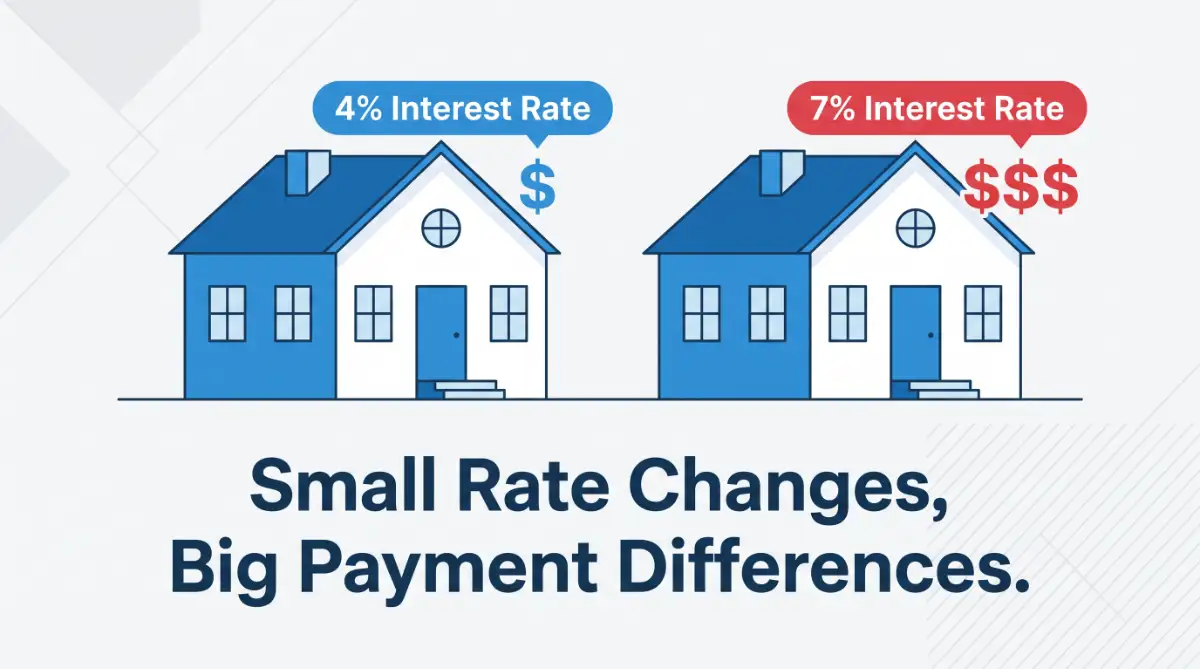
Look closely at those numbers. The difference between a 4% rate and a 7% rate on the exact same home is $658 every single month.
That is money you could use for groceries, savings, or retirement. Over the life of the loan, you end up paying $236,785 more just in interest.
This is why tracking the interest rate is just as important as negotiating the purchase price of the house.
Why Even a Tiny Rate Shift Matters to Your Budget
A small shift of just 0.25% might seem minor on paper. Lenders call this twenty-five basis points.
In reality, this small change can alter your purchasing power immediately. If your monthly budget is tight, a tiny increase can push you out of the market.
Lenders look at your Debt-to-Income (DTI) ratio when you apply for a loan. They want to make sure your monthly debts do not take up too much of your income.
When rates rise, your projected monthly payment goes up. This means you might no longer qualify for the loan amount you wanted.
You might have to look for a cheaper house or keep renting. A small rate hike literally shrinks the size of the home you can buy.
Myth vs. Reality: What You Need to Know
There are many misconceptions about how home loans work. Let us clear up some of the most common myths.
- Myth: A lower home price is always better than a lower interest rate.
- Reality: A higher interest rate on a cheaper home can sometimes cost you more monthly than a lower rate on a slightly more expensive home.
- Myth: Your interest rate is set in stone once you start looking at houses.
- Reality: You can often pay points to lower your rate, or shop around with different lenders to find a better offer.
Simple Strategies to Get the Lowest Possible Rate
You do not have to accept the first rate a lender offers you. You have more control over this number than you might think.
By taking a few deliberate steps, you can position yourself to get a much better deal. Here is how you can do it.
1. Polish Your Credit Score
Your credit score is the most important tool you have. Lenders use this score to decide how risky you are as a borrower.
A higher credit score tells lenders you pay your bills on time. They reward this good behavior with lower interest rates.
Avoid opening new credit cards before you apply for a mortgage. Keep your existing balances as low as possible.
2. Save for a Larger Down Payment
Putting more money down reduces the amount you need to borrow. This lowers the risk for the bank.
If you put down 20% or more, you also avoid paying for private mortgage insurance (PMI). This is an extra monthly fee that does not go toward your loan balance.
A larger down payment instantly lowers your monthly obligation. It also helps you get a better rate offer.
Pro Tip: Always compare offers from at least three different lenders. Rates can vary significantly between local banks, national banks, and online credit unions. Shopping around is the easiest way to save money.
How Loan Terms Affect Your Monthly Payment
The interest rate is not the only factor that decides your monthly bill. The length of your loan also plays a massive role.
The two most popular options are the 15-year fixed loan and the 30-year fixed loan. Both have clear pros and cons.
The 30-Year Fixed Mortgage
This is the most common choice for first-time buyers. Because the loan is spread over three decades, your monthly payments are much lower.
This gives you more breathing room in your monthly budget. However, you pay a higher interest rate and much more total interest over time.
The 15-Year Fixed Mortgage
With this option, you pay off your home in half the time. Lenders also offer lower interest rates for these shorter terms.
The downside is that your monthly payment will be much higher. You must be sure your income can comfortably support this larger obligation.
Looking at the Long-Term Picture
It is easy to get caught up in the stress of daily market movements. Rates go up and down based on global economic factors that you cannot control.
The important thing is to focus on what you can control. Make sure your monthly payment fits comfortably within your household budget.
Do not stretch your finances to the absolute limit just to buy a house. A home should be a place of safety, not a source of constant financial worry.
If rates are high when you buy, remember that you can often refinance later if rates go down. You are not necessarily stuck with your starting rate forever.
Plan carefully, run the numbers, and make the choice that keeps your family financially secure.
Smart Tactics to Outsmart High Borrowing Costs
Getting a home loan is not just about accepting the interest rate a lender offers you. You can take active steps to change how much interest you pay over the life of your loan.
Many successful buyers use advanced strategies to lower their monthly bills before they even sign the final papers. These steps require some planning, but the long-term savings are massive.
The Strategy of Rate Lock-ins
When you find a good rate, you do not want it to slip away while you finish your paperwork. This is where a rate lock comes into play.
A rate lock is an agreement between you and your lender to keep your interest rate at a specific percentage for a set period. This protects you if interest rates go up while your loan is being processed.
Most locks last between thirty and sixty days. If rates go down during this time, some lenders offer a "float-down" option that lets you get the lower rate.
Buying Down Your Interest Rate with Points
Another powerful tool is purchasing discount points. This is essentially paying some interest upfront in exchange for a lower rate on your monthly payments.
One point typically costs one percent of your total loan amount. In return, the lender lowers your interest rate by a set amount, often a quarter of a percent.
If you plan to stay in your home for a long time, buying points is one of the smart ways to lower your mortgage payment permanently. It helps you save thousands of dollars over the decades.
The Power of Bi-Weekly Payments
Once you secure your home loan, you can still find ways to pay less interest. One simple method is changing your payment schedule.
Instead of making one normal payment every month, you can pay half of that amount every two weeks. Because there are fifty-two weeks in a year, you will make twenty-six half-payments.
This equals thirteen full monthly payments instead of twelve. This extra payment goes directly toward your principal balance.
By using this schedule, you can shave several years off a thirty-year term. It also reduces the total interest the bank can charge you.
Tracking the Right Financial Indicators
To get the best rate, you need to understand what makes rates move. Lenders base their rates on broader economic signals.
Keep an eye on the treasury yields and inflation reports. When inflation is high, interest rates usually go up to help cool down the economy.
Knowing these trends helps you time your purchase. You can read more about how rates are calculated by exploring official loan comparison and home buying resources online.

Costly Blind Spots That Can Ruin Your Homeownership Journey
When people get excited about buying a home, they often make hasty financial decisions. These mistakes can cause years of unnecessary stress and empty your savings account.
Understanding these common traps will help you protect your family budget. Here are the errors you must avoid.
Falling for the Monthly Payment Trap
Many buyers only look at the monthly payment number when choosing a loan. They do not look at the total cost of the loan over thirty years.
A lender might offer you a lower monthly payment by extending your loan term or adding hidden fees. This can make the home seem affordable when it actually costs much more in the long run.
Always look at the total amount of interest you will pay over the entire term. This helps you see the true cost of the debt you are taking on.
The Danger of Ignoring Extra Insurance Fees
If you put down less than twenty percent of the home's price, you will likely face an extra charge. Lenders add this fee to protect themselves if you stop making payments.
This fee is called private mortgage insurance. It does not go toward paying off your home; it is simply an extra cost of borrowing.
Before committing, make sure you look into understanding private mortgage insurance explained thoroughly. Avoiding this extra fee can save you hundreds of dollars each month.
Squeezing Your Cash Reserves Too Tight
Another big mistake is using all your cash for the down payment. Buyers often forget that buying a home comes with many extra costs.
You will need money for closing costs, moving fees, and immediate home repairs. If you spend every dollar on the down payment, a single broken pipe can cause a financial emergency.
Keep a safe emergency fund in your bank account. Lenders actually prefer to see that you have several months of payments left over in savings.
Settling for the First Loan Offer
Many buyers shop for weeks to find the right house, but they spend only an hour choosing a lender. They take the first rate they are offered.
This lack of research can cost you a fortune. Different banks have different fee structures and interest rates.
Even a tiny difference in your rate can change your budget for decades. You can check current national data trends on the consumer finance updates and rate data page to ensure your offer is fair.
Your Next Steps for Financial Peace of Mind
Navigating the home loan system does not have to be a source of constant worry. With the right knowledge, you can make decisions that protect your bank account and your family.
Here is a quick action checklist to help you prepare:
- Check your credit report for errors and fix them immediately.
- Pay down existing credit card balances to improve your debt ratio.
- Shop around and get written quotes from multiple lenders.
- Calculate the long-term cost of points to see if they fit your goals.
- Keep a strong savings cushion for unexpected home expenses.
Taking these steps will give you confidence when you sit down with a lender. You will be able to ask the right questions and demand the best terms.
Remember that buying a home is a marathon, not a sprint. Take your time, analyze the math, and choose the loan that supports your long-term happiness.
Disclaimer
This article is for informational and educational purposes only. It does not constitute professional financial, legal, or real estate advice. Please consult with a certified financial planner or a licensed mortgage advisor before making any major financial decisions.