
30-Minute Pregnancy Yoga to Induce Labor Naturally & Safely
You are checking the calendar every single hour. Your due date has come and gone, or it is quickly approaching, and your body feels incredibly heavy. Every time you stand up, your lower back aches with a dull, persistent pain.
You try to sleep, but you cannot find a single comfortable position. Getting out of bed feels like a massive workout. Family and friends keep texting you, asking, "Is the baby here yet?"
Those messages are sweet, but they secretly drive you crazy. You just want this waiting game to end. You want to hold your baby, smell their sweet skin, and finally have your body back to yourself.
I still clearly remember those final, heavy weeks of my own pregnancy, waking up at 3 AM with intense lower back pain and feeling completely stuck. I tried walking blocks in the hot sun and even forced down spicy food, hoping something—anything—would finally trigger labor. It was not until I stopped fighting my body and started doing a few simple, gentle yoga flows that I felt a real, natural shift deep in my pelvis.
I know exactly how frustrated you feel right now, but I promise that specific movements can change everything for you.
The final weeks of expecting a baby are physically and mentally draining. Your mind races with anxiety about the birth process. Will it start today? What if I have to be medically induced?
This fear of medical intervention pushes many mothers to look for safe, natural alternatives at home. You might have tried eating spicy foods, walking miles around your neighborhood, or drinking specific teas. Yet, nothing seems to bring on those steady contractions.
You feel stuck, exhausted, and desperately ready for the next chapter. The good news is that you have a powerful tool right inside your own body. By using specific, targeted movements, you can create the perfect environment for your baby to drop lower and trigger the birth process. Let us explore exactly how you can use intentional movement to encourage your little one to finally make their arrival.

Looking Back: From Early Struggles to the Final Countdown
Think about the very beginning of this amazing journey. It probably feels like a lifetime ago. Back then, your biggest worry was figuring out how to survive the day without feeling sick.
You likely spent hours reading a Pregnancy nutrition guide just to understand what was safe to eat. Dealing with intense morning sickness felt like the hardest challenge you would ever face. You had to learn everything about Managing pregnancy nausea while trying to maintain your normal daily routine birth preparation stretches natural labor induction gentle prenatal yoga preparing body for birth easy yoga flow
Your First trimester diet probably consisted of plain crackers, ginger ale, and whatever you could easily keep down. You relied on specific Nausea relief foods to get through your work shifts. You quickly became an expert at Prenatal dietary hacks just to make sure you and your baby were getting enough nutrients.
You probably tried different methods of Pregnancy meal planning to avoid smells that made you sick. You constantly searched for Pregnancy health tips and general Health tips to feel better. You realized that good Women health requires a lot of patience and adaptation.
Your commitment to Healthy eating for moms was strong, even when nothing sounded appetizing. Now, your body has completely transformed. The focus has entirely shifted away from morning sickness and early struggles.
Today, you are focused on meeting your baby. The best way to transition into this final stage is through Pregnancy Yoga. Engaging in an easy yoga flow can completely change how your body prepares for delivery.
How Movement Signals Your Body to Start Birth
When you are trying to encourage birth, you need to think about gravity and space. Your baby needs room to move down into the birth canal. birth preparation stretches are designed to create that exact space.
If you spend all day sitting on a soft couch, your pelvis tilts backward. This makes it harder for the baby's head to apply pressure to your cervix. Pressure on the cervix is exactly what tells your brain to release oxytocin, the hormone that causes contractions.
By practicing gentle prenatal yoga, you actively shift your pelvis forward. This allows gravity to do the heavy lifting for you. It is a highly effective form of natural labor induction that you can do safely in your living room.
third trimester exercises are not about burning calories or building muscle. They are entirely focused on relaxing tight ligaments and finding physical balance. When your muscles are relaxed, your baby can navigate the tight space much easier.
This is why preparing body for birth is as much about relaxation as it is about movement. When you are stressed, your body produces adrenaline. Adrenaline actually stops labor from happening because your body thinks you are in danger.
Using an easy yoga flow lowers your adrenaline and tells your body that you are safe. This is a very important part of natural labor induction. Now, let us look at how you can structure a simple, effective routine.
A Quick Myth vs Reality Check
Myth: You need to do intense, exhausting workouts to force the baby out.
Reality: Exhausting yourself before birth is a bad idea. gentle prenatal yoga is far more effective because it relaxes the muscles instead of tensing them.
Myth: Yoga will instantly break your water and start contractions in five minutes.
Reality: birth preparation stretches help position the baby properly. This creates the optimal environment for birth to begin naturally over the next few days.
The 30-Minute Routine: Step-by-Step Breakdown
Looking back, my biggest mistake was thinking I needed to break a sweat to make the baby move down. I spent hours wearing myself out, only to realize that tight, exhausted muscles actually block labor from starting. Once I switched my focus to slow pelvic tilts and deep breathing on my living room rug, I finally felt the baby drop properly. Take it from me: relax your jaw, focus on softening your inner thighs, and let gravity do the hard work for you.
You do not need to be a fitness expert to do this. You just need comfortable clothes, a soft mat, and a quiet space. Let us break down this 30-minute session into easily manageable blocks.
Minute 0 to 5: Grounding and Breathwork
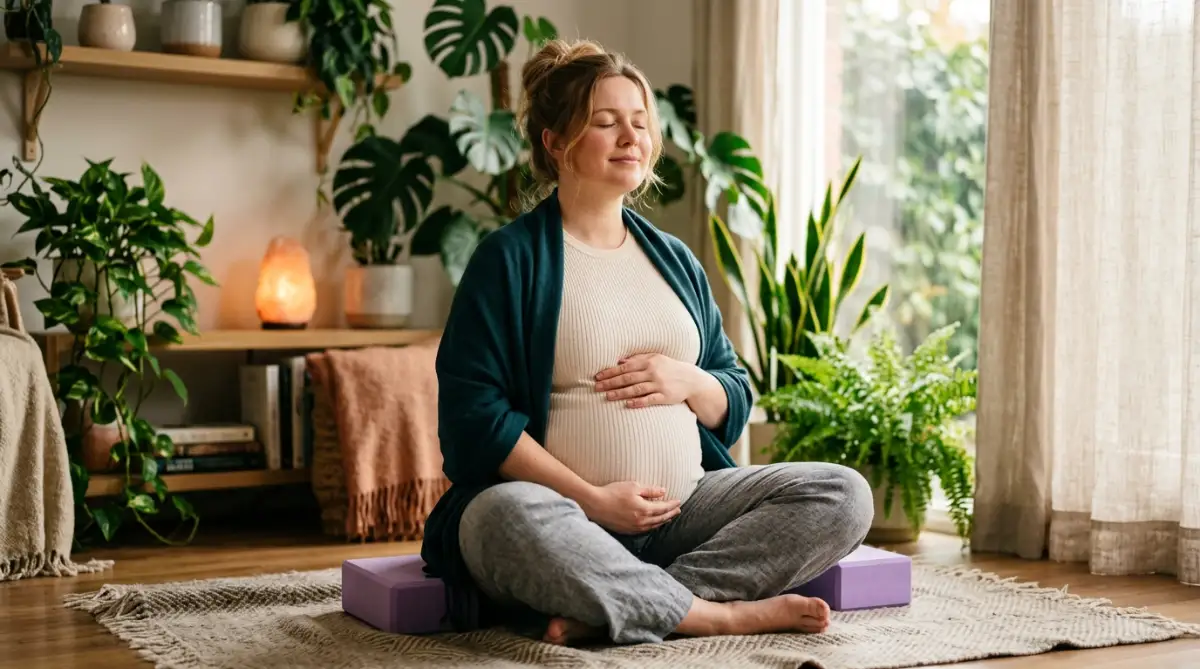
Start by sitting comfortably on your mat. You can sit cross-legged or on a soft cushion. Close your eyes and place one hand on your chest and the other on your belly.
Take a deep breath in through your nose, expanding your belly like a balloon. Exhale slowly through your mouth, making a soft sighing sound. This type of breathing is one of the best third trimester exercises you can do.
It directly calms your nervous system. Spend five full minutes just focusing on the air moving in and out. This is a core part of preparing body for birth because you will use this exact breath during contractions pelvic floor exercises third trimester exercises preparing body for birth birth preparation stretches gentle prenatal yoga
Let go of the frustration of waiting. Talk to your baby in your mind. Tell them that you are ready and that it is safe to come out now.
Minute 5 to 12: The Cat-Cow Flow
If you are a visual learner, watch this quick demonstration below to see exactly how to flow through these pelvic movements safely. Take a few minutes to watch the correct form, and then keep reading to learn the best hip-opening stretches you need for the next step!
Slowly transition onto your hands and knees. Make sure your wrists are directly under your shoulders and your knees are under your hips. This position is a staple in Pregnancy Yoga.
As you inhale, gently drop your belly toward the floor and lift your chest. Do not overstretch your lower back; just move gently. This is the "Cow" position.
As you exhale, round your back up toward the ceiling, tucking your chin toward your chest. This is the "Cat" position. Move back and forth between these two shapes with your breath.
This movement is incredible for natural labor induction. It encourages the baby to turn into the best position for birth, with their spine facing your belly. It also relieves a massive amount of pressure from your lower back.
Do this slow, easy yoga flow for about seven minutes. If your wrists start to hurt, you can drop down onto your forearms. Always listen to your body and modify the movements to fit your comfort level.
Minute 12 to 20: Hip Circles and Pelvic Tilts
Stay on your hands and knees for this next part. Begin to move your hips in large, slow circles. Imagine you are drawing a big circle on the wall behind you with your tailbone.
These are powerful pelvic floor exercises that help loosen the joints. Move clockwise for a few minutes, then switch to counterclockwise. This motion helps rock the baby's head deeper into your pelvis.
Next, try some simple pelvic tilts. While on your hands and knees, just tuck your tailbone under and then release it. You can even do this while leaning over an exercise ball.
birth preparation stretches like these are highly recommended by midwives and doulas. They create flexibility in the exact areas that need to open during delivery. Keep your breathing deep and steady the entire time.
Minute 20 to 25: Butterfly Pose and Malasana (Deep Squat)
Carefully move back into a seated position. Bring the soles of your feet together in front of you, letting your knees drop out to the sides. This is known as Butterfly pose.
Hold onto your ankles and gently flutter your knees up and down. This is one of the most effective pelvic floor exercises for stretching the inner thighs. It opens the entire pelvic area beautifully.
If you feel comfortable and balanced, you can transition into Malasana, or a deep yogic squat. Stand up slowly, step your feet wider than your hips, and point your toes outward. Slowly lower your hips all the way down toward the floor third trimester exercises gentle prenatal yoga natural labor induction easy yoga flow pelvic floor exercises
If your heels do not touch the ground, place a rolled-up towel under them for support. You can also lean your back against a wall so you do not fall over. Squatting is heavily used in preparing body for birth because it opens the pelvic outlet by up to 28 percent.
Hold this squat for a few deep breaths, then slowly stand back up. Never hold a squat for too long if it causes pain. gentle prenatal yoga should always feel supportive, never painful.
Minute 25 to 30: Final Relaxation (Savasana)
For the final five minutes, it is time to rest. You should not lie flat on your back during this stage of pregnancy. Instead, lie comfortably on your left side.
Place a thick pillow between your knees and another one under your belly for support. Close your eyes and return to your deep, slow breathing. This rest period is a key part of your easy yoga flow.
Your body integrates all the wonderful movements you just did. This deep state of relaxation is when oxytocin is most likely to flow freely. Allow yourself to drift into a peaceful state of mind.
Visualize your cervix softening and opening like a blooming flower. Visualize your baby moving down smoothly and easily. Positive visualization is a powerful mental trick for natural labor induction.
Nourishing Your Body for the Big Event
Physical movement is just one piece of the puzzle. You also need to make sure your body has the energy it requires for the marathon of labor. Let us briefly talk about nutrition in these final days.
You might remember how carefully you followed your Pregnancy nutrition guide in the beginning. You survived those early days by heavily Managing pregnancy nausea. You relied on simple Nausea relief foods to keep your energy up.
Your First trimester diet was likely very restricted. But right now, you need high-quality fuel. You can use the same Pregnancy meal planning skills you learned back then to prepare for birth.
Start making small, easily digestible meals. Use your best Prenatal dietary hacks to sneak extra protein and healthy fats into your snacks. Read up on fresh Pregnancy health tips that focus on energy building.
Good Women health practices are essential right up until the moment you deliver. Focus on Healthy eating for moms by adding dates and red raspberry leaf tea to your routine, as many believe they help tone the uterus. All of these Health tips work together with your yoga practice to prepare you.
Pro Tips for Maximum Success
Practicing this routine once might feel great, but consistency is the real secret. Try to do this 30-minute sequence every single day once you hit 39 weeks. Make it a special, non-negotiable part of your daily routine.
Pro Tip 1: Use an exercise ball. Sitting and bouncing gently on a birthing ball while watching television is a great addition to your third trimester exercises. It keeps your pelvis open without requiring any extra effort.
Pro Tip 2: Involve your partner. Have them gently massage your lower back while you are in the Cat-Cow position. Physical touch from a loved one boosts oxytocin levels, which aids in natural labor induction.
Pro Tip 3: Set the mood. Dim the lights, play soft instrumental music, and diffuse some calming lavender oil. Creating a spa-like environment helps you get the most out of your birth preparation stretches.
Understanding Your Pelvic Floor Connection
Many women misunderstand how the pelvic floor works during delivery. We often think we need to push with all our might. However, successful pushing actually requires a relaxed pelvic floor.
When you do your pelvic floor exercises like the Butterfly pose, focus on the sensation of letting go. Imagine the muscles melting and softening. If you tighten up out of fear, the baby has a much harder time passing through.
Practicing this release during your gentle prenatal yoga trains your brain. When real contractions hit, your muscle memory will take over. Instead of clenching in pain, you will naturally breathe and release.
This mind-body connection is a massive part of preparing body for birth. The physical stretches are excellent, but the mental conditioning is what truly gets you through labor. Yoga teaches you how to stay calm inside the storm.
When to Contact Your Doctor
While this easy yoga flow is safe for most healthy pregnancies, you should always be smart. If your water breaks, stop exercising and call your care provider. If you experience sharp, sudden pain that does not go away, get medical attention.
Do not try to force labor if your doctor has advised against it due to medical reasons. If you have placenta previa, high blood pressure, or are expecting multiples, you need personalized advice. Always run new third trimester exercises past your midwife or doctor first.
Most providers will be thrilled to hear you are doing birth preparation stretches. They know that active mothers tend to have shorter, less complicated labors. They will likely encourage you to keep moving.
Pushing Past the Basics: Maximizing Your Body's Preparedness
If you have already started incorporating movement into your daily routine, you are doing a fantastic job. You might have noticed a slight drop in your belly, or perhaps you feel a bit more pressure low in your pelvis. These are excellent signs that your body is responding to the Pregnancy Yoga you are practicing.
However, there is a big difference between just going through the motions and truly optimizing your physical state. Many women do basic stretches but miss out on the subtle, powerful techniques that make a real impact. If you want to encourage natural labor induction, you need to understand how your habits outside of your 30-minute session affect your progress.
Your body is a highly connected system. The way you sit, the way you breathe, and even the way you handle stress all play a part in preparing body for birth. Let us explore some advanced strategies that can significantly increase your chances of meeting your baby sooner.
The Art of Active Resting
We often think of rest as doing absolutely nothing, like melting into a soft sofa. But during your final weeks, passive resting can actually work against you. Sinking deep into a soft chair causes your pelvis to tuck backward, which is the exact opposite of what you want.
Instead, practice active resting. When you sit to watch a movie, choose a firm chair or sit on a birthing ball. Sitting on a ball naturally engages your core and encourages proper pelvic alignment.
If you must sit on the couch, place a firm pillow behind your lower back. You want to ensure your knees are always slightly lower than your hips. This simple shift in posture keeps gravity working in your favor all day long, not just during your dedicated third trimester exercises.
Connecting Diet and Muscle Function
You might be surprised to learn that what you eat directly impacts how well your muscles relax and contract. By now, you have probably moved past your First trimester diet and those intense cravings. You are no longer desperately searching for Nausea relief foods just to survive the afternoon.
Right now, your muscles need specific nutrients to perform the heavy lifting of labor. A well-hydrated body is essential for maintaining strong, effective contractions. In fact, drinking enough water directly supports the protective environment around your baby, ensuring everything functions smoothly.
If you are dehydrated, your uterus can become irritable, leading to false labor pains that do not actually progress. You can easily prevent this by keeping a large water bottle nearby. Using simple Prenatal dietary hacks like adding a pinch of sea salt or a squeeze of lemon can also help your body absorb that hydration better.
You should also look closely at your Pregnancy meal planning to ensure you are getting enough magnesium. Magnesium is nature's muscle relaxant. It helps prevent cramps and allows your pelvic floor to soften during your pelvic floor exercises.
Including dark leafy greens, nuts, and seeds in your meals is an excellent strategy. Good Healthy eating for moms right now means focusing on foods that build stamina. Think of your upcoming birth as an athletic event; you need premium fuel to cross the finish line.
The Secret Power of Asymmetrical Movement
Most traditional birth preparation stretches are symmetrical, meaning both sides of your body do the same thing. Think of a deep squat or the Butterfly pose. While these are wonderful for creating space, they do not always help if your baby is stuck in an awkward position.
This is where asymmetrical movement becomes incredibly helpful. This means moving one side of your body differently from the other. A great example is stair walking, but with a twist.
When you walk up a flight of stairs, try stepping sideways, two steps at a time. Hold onto the railing for balance and move slowly. This alternating motion slightly shifts the pelvic bones back and forth.
This shifting action can jiggle a stubborn baby into a better, lower position. Another excellent asymmetrical move is the "Curb Walk." Find a safe street with a low curb and walk with one foot on the curb and one foot on the street.
The slight unevenness of your hips encourages the baby to navigate through the pelvic brim. These small, targeted actions are highly effective forms of natural labor induction. They complement your gentle prenatal yoga practice perfectly.
Mastering the Downward Mental Shift
You can stretch your body perfectly, but if your mind is tense, your cervix will remain tightly closed. Many women experience a sudden surge of adrenaline right before labor begins. They start cleaning the house frantically, making last-minute lists, and stressing over tiny details.
This stress response tells your brain that it is not safe to give birth yet. You have to intentionally create a downward mental shift. This means actively telling yourself that all the preparation is done and it is time to surrender.
Spend time every evening practicing deep visualization. Picture a warm, golden light starting at the top of your head and slowly moving down to your toes. As the light reaches your pelvis, imagine the muscles melting like warm butter.
This mental practice is just as important as your physical Pregnancy Yoga. It trains your nervous system to respond to pressure with relaxation instead of fear. The more you practice this now, the easier it will be when active labor finally begins.
The Hidden Traps That Stall Your Progress
It is incredibly frustrating when you feel like you are doing everything right, but nothing is happening. Sometimes, it is not about what you are failing to do. Often, it is about small, well-meaning habits that are unknowingly working against you.
Many expecting mothers fall into hidden traps that actually delay the onset of labor. These mistakes are common because they are rooted in a desire to be proactive. Let us look closely at what you should stop doing immediately.
Pushing Your Body into Exhaustion
The most common trap is the belief that harder work equals faster results. You might feel tempted to walk four miles a day, scrub the floors on your hands and knees, and do endless squats. You think that if you exhaust yourself, the baby will have no choice but to come out.
This approach almost always backfires. Labor requires a massive amount of physical energy. If you deplete all your reserves trying to start labor, you will have nothing left when the real work begins.
An exhausted body will often shut down and stop contractions completely. This is why gentle prenatal yoga is far superior to intense cardio right now. Your focus should be on creating space and relaxation, not burning calories or breaking a sweat.
Obsessing Over Sensation and Signs
It is completely natural to analyze every twinge, ache, and cramp. You might find yourself constantly timing irregular contractions on an app, hoping they form a pattern. But obsessing over every little sign can quickly turn into anxiety.
When you are highly anxious, your body releases cortisol, the stress hormone. High levels of cortisol directly block the production of oxytocin. Without enough oxytocin, your body simply cannot begin the birth process.
You must stop staring at the clock and overanalyzing your body. Instead of stressing, focus on simple Pregnancy health tips that keep you grounded. Read a book, watch a funny movie, or bake some cookies. Distraction is often the best remedy for a stalled labor.
Ignoring Balanced Blood Sugar
You might not realize how closely your blood sugar is tied to your hormone levels. Eating large amounts of sugary treats or skipping meals can cause massive spikes and crashes. These fluctuations stress your body on a cellular level.
If you previously had to follow an easy meal plan for expecting moms to manage gestational diabetes, you already know how important this balance is. Even if you do not have diabetes, maintaining steady blood sugar is essential right now. Your uterus is a giant muscle, and it needs steady, reliable energy to contract effectively.
If your blood sugar crashes, your body might pause early labor symptoms to protect itself. You can avoid this by sticking to your Healthy eating for moms principles. Eat small, balanced snacks containing protein and complex carbohydrates every few hours.
Good Women health practices dictate that you treat your body with extreme care during this vulnerable time. Avoid the temptation to skip meals just because you feel uncomfortable or heavy. Consistent nourishment directly supports your body's ability to transition into labor.
Clenching Through the Discomfort
As your baby moves lower, you will inevitably feel sharp pains in your hips and groin. This is often called "lightning crotch," and it can take your breath away. The natural human response to sudden pain is to tense up and hold your breath.
If you start clenching your pelvic muscles every time you feel a twinge, you are creating a major roadblock. You are essentially tightening the exact door your baby is trying to push open. This constant tightening can lead to a longer, more painful early labor phase.
This is why your easy yoga flow is so important. It teaches you to breathe into the discomfort rather than fighting it. The next time you feel a sharp pain, consciously drop your shoulders, unclench your jaw, and exhale deeply.
Stepping confidently into Your Birthing Day
You are standing on the edge of one of the most transformative experiences of your life. The waiting is heavy, the discomfort is real, and the anticipation is overwhelming. But you are not powerless in this process.
Your body was designed for this exact moment. By committing to a daily practice of intentional movement, you are actively participating in your baby's journey into the world. You are using the principles of gravity, relaxation, and alignment to clear the path.
Remember that preparing body for birth is not just about physical flexibility. It is about emotional readiness and trusting your own strength. Every stretch you do, every deep breath you take, is a message of welcome to your little one.
You have navigated the complexities of Managing pregnancy nausea and figured out the best Pregnancy nutrition guide for your lifestyle. You have read endless Health tips and adapted to every change your body threw at you. You are already an incredibly strong and capable mother.
Now, it is time to let go of the calendar and stop counting the days. Focus on the present moment and treat your body with immense kindness. Roll out your mat, turn on some soft music, and allow yourself to sink into deep relaxation.
Your baby knows the way, and your body knows exactly what to do. Keep moving gently, stay well-nourished, and breathe deeply. You are incredibly close to meeting the love of your life.
Disclaimer:
The information provided in this article is for educational and informational purposes only. It does not substitute professional medical advice, diagnosis, or treatment. Always consult with your healthcare provider or midwife before beginning any new exercise routine or attempting to naturally induce labor, especially if you have a high-risk pregnancy.
The final stretch of waiting is undoubtedly tough. You are tired, uncomfortable, and beyond ready. But remember that your body is incredibly wise.
It knows exactly what to do and when to do it. By practicing Pregnancy Yoga, you are simply giving your body a gentle nudge in the right direction. You are showing your baby that the door is open and the path is clear.
I look at my sweet baby today and I am so grateful I trusted my body enough to gently guide it into labor, rather than forcing it. You have incredible strength inside of you, and this simple routine is the exact tool you need to unlock it. Grab a pillow, find a quiet spot on your floor tonight, and take that first deep breath—you are completely ready for this.
Trust in the process. Trust in your strength. Every single breath you take brings you one moment closer to holding your beautiful baby in your arms. Roll out your mat today, take a deep breath, and let the magic of movement begin.