
Breaking Down Model Context Protocol (MCP): Everything You Need to Know
Imagine you are sitting at your desk, sipping your morning coffee, and staring blankly at your computer screen. You have an incredible ai agent ready to assist you.
You type a brilliant prompt, asking it to summarize a massive financial report sitting on your hard drive. But instead of a helpful answer, you hit a massive brick wall.
I remember the exact moment I almost threw my laptop out the window. I had just spent two hours trying to get my smart assistant to read my messy project folders, only to realize I was wasting more time manually copying data than actually doing real work. That was my painful wake-up call, and it pushed me to find a system that actually connects to my files without making me want to pull my hair out.
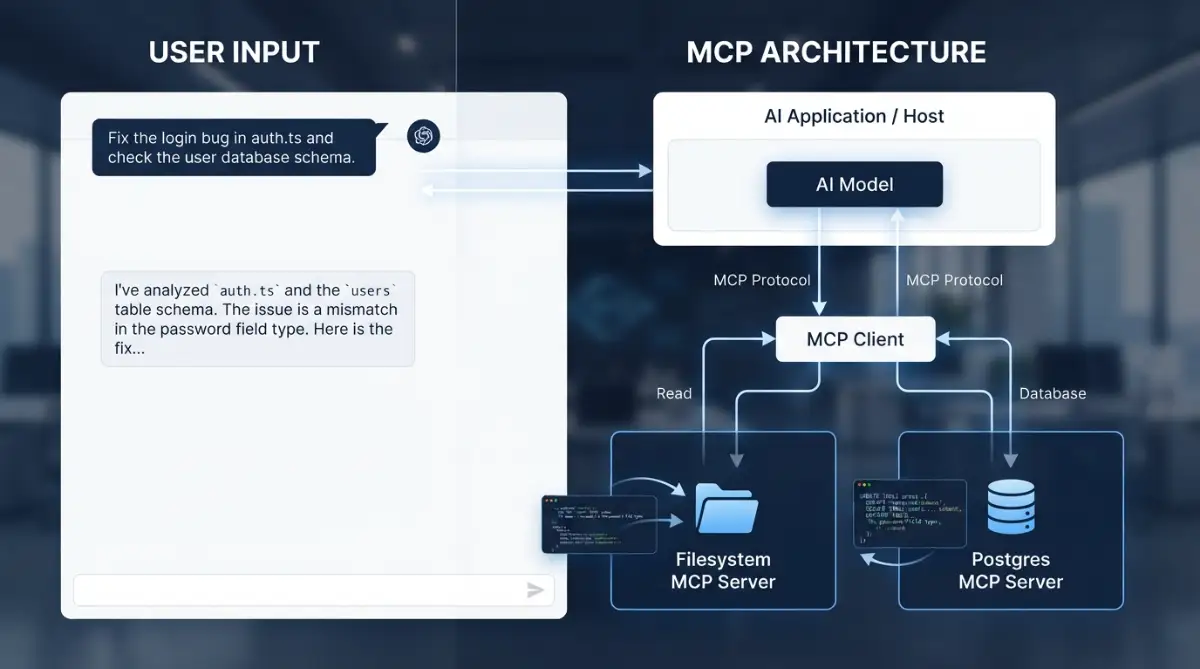
The machine simply cannot see your files. It lacks a direct local data connection. You suddenly feel a rush of frustration because you know the technology is smart enough, but it just cannot reach the information it needs.
This is the hidden struggle thousands of professionals face every single day. We are surrounded by incredibly smart assistants like chatGPT and GoogleGemini. Yet, getting them to securely read our personal documents or interact with our private databases feels like trying to speak to someone through a thick, soundproof glass wall.
You end up copying and pasting huge blocks of text manually. You waste precious hours formatting data just so the machine can understand it. Your mental peace slowly drains away as you juggle multiple tabs, messy scripts, and unreliable third-party plugins.
Why should a simple local data connection be this difficult? Why does AI model integration always feel like a complicated science experiment?
Many users try to build custom bridges using heavy coding. But these custom solutions break easily. Whenever a company updates their system, your hard-earned setup collapses.
You lose time, you lose patience, and you lose trust in the very tools designed to make your life easier. This lack of universal API standards is causing daily headaches for writers, developers, and everyday computer users alike.
We clearly need a better way. We need a system that acts like a universal translator between our private files and these powerful external brains.
Decoding the Magic: What Makes Things Connect?
To fix this massive headache, the tech world quietly introduced something revolutionary. It is called the Model Context Protocol (MCP).
At its core, the Model Context Protocol (MCP) is an open-source standard designed to connect intelligent systems to your private data sources safely. Think of it as a highly secure, standardized bridge.
Instead of building a unique, wobbly bridge every time you want to connect a new tool, you now have a solid, universal highway. This highway relies on universal API standards that everyone can follow.
Let us break this down into simple, practical steps so you can understand exactly how to apply this logic to your own daily workflow.
The Architecture of a Seamless Connection
Whenever you type a prompt into a smart chat interface, a complex journey begins behind the scenes. Before this new system existed, the machine was isolated on an island.
Now, with a proper AI model integration, the system operates using three main components. Let us look closely at how these parts work together in perfect harmony.
First, you have the Host. The Host is the application you are actually looking at on your screen.
If you are using a smart editor or a custom ai agent, that interface is the Host. The Host is responsible for taking your human instructions and preparing them for the next step.
Next, we have the Client. The Client acts like a highly trained messenger.
The Client takes the request from the Host and runs across the bridge. Its only job is to find the right information without messing anything up. This ensures seamless tool execution every single time you hit the enter key.
Finally, we have the Servers. These are small, lightweight programs sitting right next to your private data.
When the Client arrives, it politely asks the Server for specific information. Because they communicate using strict secure environment protocols, the Server only hands over exactly what was requested. Nothing more, nothing less.
Why This Changes Your Daily Workflow
Let us look at a real-life scenario. Suppose you are managing a large project and collaborating with your team.
You are using a shared digital workspace. Managing this type of cloud cowork setup requires incredible organization.
You want to ask your digital assistant a question about a specific client. In the past, you would have to download the client's file, open it, copy the contents, and paste it into the chat window.
Now, thanks to this standardized protocol, things are entirely different. Your assistant simply uses its local data connection to read the client file directly from your secure database.
It happens instantly. There is no copying, no pasting, and zero risk of accidentally leaking sensitive information onto the public internet. This level of AI model integration gives you your valuable time back.
Expert Insight: The Power of Open Standards
"When developers agree on a single way to communicate, magic happens. We stop wasting time fixing broken connections and start building tools that actually help people."
This quote perfectly captures why universal API standards matter. When everyone speaks the same language, the entire ecosystem thrives.
Imagine if every brand of television required a completely different type of electrical outlet. It would be chaos.
By standardizing how data flows, developers can create secure environment protocols that protect you. You can confidently link your private notes, your code repositories, and your financial sheets without fear.
Setting Up Your First Data Bridge
How do you actually use this in your daily life? It is surprisingly simple.
You do not need to be a senior programmer to benefit from this technology. You just need to choose applications that support these new communication rules.
Let us say you are experimenting with modern tools like gamma ai for creating presentations. You might also be testing out chatGPT for writing emails.
Maybe you even prefer Cloude for analyzing large documents, or GoogleGemini for fast research.
Regardless of which tool you prefer, the goal remains the same. You want a smooth, reliable local data connection.
To start, you will install a small "Server" application on your computer. This Server acts as the gatekeeper for your files.
If you want your intelligent assistant to read your computer's file system, you install a file system server. It takes about two minutes and requires zero complex coding.
Once installed, you tell your main application to talk to this new server. The two systems shake hands, agree on the secure environment protocols, and the bridge is open.
If you are a visual learner, watch this quick video breakdown below to see exactly how this data bridge connects in real time. After watching, keep reading to learn how to avoid the hidden security traps that most beginners accidentally fall into!
Myth vs Reality in Modern Connectivity
Let us clear up some common confusion. Many people have misunderstandings about how these systems actually handle private information.
Myth: Giving a machine access to my local files means it can read everything on my computer.
Reality: Absolutely not. The system uses strict secure environment protocols. You define exactly which folders it can see. It cannot look at anything outside of those specific folders.
Myth: I need to know advanced programming to use this.
Reality: Modern tools make this process visual and easy. Setting up a local data connection often just requires clicking a few buttons and approving permissions.
Myth: This only works for massive corporate databases.
Reality: It is designed for everyone. Whether you are managing a massive cloudDesign project or just organizing your personal grocery lists, universal API standards work exactly the same way.
Expanding the Capabilities with Tools
One of the most exciting features of this system is the ability to use external tools automatically. We call this seamless tool execution.
Imagine you ask your assistant to check the current weather in Tokyo and then save that information into a text file on your desktop.
Without a proper protocol, the assistant would just give you the weather and ask you to create the file yourself. It is helpful, but not completely autonomous.
With this new protocol, the assistant can reach out, grab the weather data, and then ask your local server to write the text file.
This seamless tool execution turns a simple chat interface into a powerful command center. It bridges the gap between just talking about doing something and actually getting it done.
The Role of Prompts and Context
Let us talk about how you communicate. A good prompt is essential for getting good results.
When you provide clear instructions, the system knows exactly which server to ask for help.
For example, if you are working on a creative project, you might use gamma ai or plain gamma to generate visual ideas.
If you need heavy data analysis, you might rely on GeminiSpark or Cloude.
By giving a detailed instruction, you provide the necessary context. The Model Context Protocol (MCP) takes your instruction and packages it perfectly for the receiving server.
Because the system relies on universal API standards, the context is never lost in translation. The server receives the exact instruction, understands the goal, and returns the precise data needed.
Organizing Your Digital Workspace
To truly benefit from this, you need to keep your digital space clean. A messy hard drive will only confuse the system.
If you are setting up a workspace for cloud cowork, ensure your folders are clearly named.
When you establish a local data connection, point the server to highly organized directories. This makes AI model integration much smoother.
Think of it like inviting a very smart librarian into your home. If your books are scattered all over the floor, the librarian will struggle to find anything.
If your books are neatly arranged on shelves, the librarian can find exactly what you need in seconds. Good cloudDesign principles apply directly to your local file management.
Understanding Security and Permissions
We must talk about safety. Opening up your private files can feel intimidating.
This is why secure environment protocols are built into the very foundation of this system.
Every single time an external system wants to read or write a file, it must ask for permission. You, as the human user, remain in total control.
You can set rules that say, "You may read these files, but you are never allowed to delete or change them."
This level of control ensures seamless tool execution without risking your important data. It gives you the confidence to explore new workflows securely AI model integration universal API standards local data connection secure environment protocols seamless tool execution
The Future of Personal Assistants
As we look forward, the lines between different brands are starting to blur.
Whether you are a fan of chatGPT, heavily invested in GoogleGemini, or exploring niche tools like GeminiSpark, the underlying plumbing is becoming the same.
This standardization means you do not have to lock yourself into one ecosystem. You can mix and match the best parts of different systems.
You can use one tool for writing, another for coding, and a third for generating gamma style presentations.
They will all be able to read your local context because they all respect the same universal API standards. This is true freedom for the modern computer user.
Practical Table: The Old Way vs The New Way
This simple comparison shows why the industry is shifting so rapidly. The old way was exhausting.
The new way respects your time and energy. It allows you to focus on being creative and productive, rather than acting as a manual data entry clerk for a machine.
Making the Most of Your Setup
To get the absolute best results, start small. Do not try to connect your entire hard drive on day one.
Pick one single project. Maybe it is a folder containing a few PDF research papers.
Set up the server to watch just that one folder. Then, open your favorite ai agent and ask a question about those papers.
Watch how fast and accurate the response is. Experience the magic of a secure local data connection firsthand.
Once you feel comfortable, you can slowly expand its access. You can add more folders, connect different databases, and start automating small daily tasks.
Every time you execute a complex prompt and get a perfect result instantly, you will realize how powerful AI model integration has become.
The Model Context Protocol (MCP) is not just a technical term for software engineers. It is a fundamental shift in how humans and computers collaborate.
By removing the friction and establishing secure environment protocols, it allows technology to finally keep its promise. It makes our machines truly helpful, context-aware assistants that respect our privacy and boost our daily output.
We no longer have to struggle with broken bridges. The universal highway is here, and it is ready for you to drive on.
Taking Full Control of Your Intelligent Assistant
Now that you understand the basic mechanics, it is time to push this technology to its absolute limits. Setting up a simple folder connection is just the beginning of your journey.
If you want to experience the true magic of the Model Context Protocol (MCP), you need to think like a system architect. You need to organize your digital life so your tools can serve you better.
I often see people set up their first ai agent and expect it to magically read their mind. The truth is, these systems rely heavily on how well you structure your daily workflow universal API standards seamless tool execution AI model integration local data connection prompt engineering
Think of your digital assistant as a highly skilled intern who just joined your company today. This intern is incredibly smart but knows absolutely nothing about where you keep your files.
If you just point them to a messy filing cabinet, they will waste hours searching for basic information. The same logic applies to your machine assistants.
You must create a highly organized environment if you want your tools to perform well. Let us explore exactly how you can set up a workspace that guarantees perfect results every single time.
Advanced Strategies for Managing Your Digital Files
The first major secret to long-term success is separating your raw data from your active projects. You should never point your ai agent to your entire "Documents" folder.
Instead, create highly specific folders for specific tasks. For example, if you are working on a collaborative project, set up a dedicated directory for your cloud cowork materials.
When you type a prompt, the machine will only search within that dedicated space. This dramatically speeds up the response time and prevents the system from pulling irrelevant information.
Let us say you are designing professional presentations for a major client meeting. You would create one folder containing just the client's logos, text drafts, and historical data.
You then tell the local server to only look at that specific presentation folder. When you use tools like gamma ai or gamma, they will instantly grab the right colors and text without making mistakes.
This level of detailed organization makes your cloudDesign projects flow incredibly smoothly. You stop fighting with the machine and start co-creating with it.
The Power of Contextual Naming
Another pro-level secret is how you name your files and folders. Machines do not understand human emotion, but they do understand clear labels.
Never name a document "Draft_Final_V2.pdf". A smart assistant looking at that file has no idea what the document actually contains.
Instead, use descriptive names like "Q3_Financial_Report_Marketing_Budget.pdf". When your prompt asks about marketing budgets, the system immediately knows exactly which file to open first secure environment protocols local data connection seamless tool execution; AI model integration universal API standards
This simple habit changes everything. It turns a frustrating search process into a lightning-fast data retrieval system.
Expert Q&A: Maximizing Your Setup
Question: Should I keep my local server running all the time?
Answer: You only need to run the server when you are actively working. Turning it off when you step away is a great way to ensure complete privacy.
Question: Can I connect multiple tools to the same folder?
Answer: Yes. Because this uses standard rules, you can have chatGPT analyzing the text while Cloude organizes the data. They can both safely read from the same location.
Question: What if my machine slows down?
Answer: This usually happens if you give the system too many files to read at once. Always limit access to the exact folders you need for your current task.
If you are interested in pushing these boundaries further, you should learn about creating custom AI assistants tailored exactly to your daily routine. Building your own custom setup gives you ultimate flexibility.
The Hidden Traps That Break Your Connection
We need to have a very serious conversation about safety and common errors. While the Model Context Protocol (MCP) is built to be safe, human error can quickly turn a great tool into a massive security risk.
Many people get overly excited when they first see this technology working. They want their digital assistant to do everything, so they start breaking the rules.
They bypass the safety warnings just to make things work faster. This is a terrible idea that can lead to severe data loss or privacy breaches.
Imagine giving a stranger the master key to your entire house just because you wanted them to water one plant in the living room. That is exactly what happens when you mismanage your file permissions.
You must remain vigilant and protective of your personal information. Let us walk through the most dangerous mistakes people make and how you can completely avoid them.
Giving Root Access to Your Entire Drive
The single biggest mistake you can make is giving your local server access to your root hard drive (like your entire C: drive). This is incredibly dangerous.
If you do this, any external system can technically request to read your personal tax returns, your saved passwords, or your private family photos. Even though modern tools are generally safe, you should never leave your front door wide open.
Always use strict folder containment. Only approve connections to folders that contain the exact data you want to share.
If you are researching a topic with GoogleGemini, create a temporary folder just for that research. Put your downloaded articles there, connect the server, and delete the folder when you are done.
Following established modern cybersecurity frameworks ensures you never expose sensitive information by accident. Security should always be your number one priority when connecting local files to the internet.
Ignoring Read and Write Permissions
Another massive pitfall is failing to understand the difference between reading a file and writing over a file. These are two completely different actions.
By default, you should always set your server to "Read-Only" mode. This means the ai can look at your documents, but it cannot change or delete them under any circumstances.
People often get lazy and grant full "Write" access because they want the assistant to edit a document directly. This is a huge gamble.
If the system misinterprets your prompt, it might accidentally delete a massive paragraph of important text. It might overwrite a file you spent three weeks creating.
Always keep your original files locked in Read-Only mode. If you want the system to generate new text, ask it to create a completely new file next to the original one.
The Hoarder’s Digital Workspace
We touched on this earlier, but a messy workspace will ruin your experience with GeminiSpark or any other advanced tool. A cluttered folder structure completely breaks the connection logic.
When you dump thousands of unrelated files into one single folder, the server gets overwhelmed. The client asks for a specific piece of data, and the server has to scan through ten years of digital junk to find it.
This causes massive delays. Your screen will freeze, the connection will time out, and you will think the technology is broken.
I made this exact mistake when I first started, dumping hundreds of random PDFs into one single folder just to see what the machine could do. My computer completely froze for ten minutes, which taught me the hard way that a clean, simple workspace is the real secret to making this whole system run like magic.
The technology is fine; your organization is the problem. Treat your digital workspace with the same respect you give your physical office desk.
Do's and Don'ts for a Healthy Connection
- Do test your setup with fake, non-sensitive data first before connecting your real work files.
- Don't leave your server running unattended if you are working on highly confidential client projects.
- Do update your server software regularly to ensure you have the latest security patches.
- Don't use vague names for your folders. Be highly descriptive so the machine knows exactly where to look.
- Do monitor your command logs occasionally to see exactly what files your assistant is requesting behind the scenes.
When you follow these safety measures, you eliminate the stress of data management. You can confidently rely on standardized tool use protocols without losing sleep over your privacy.
Structuring Complex Commands for Perfect Results
Let us talk about how you actually speak to these connected systems. Once your bridge is secure and your files are organized, your words become the most powerful tool you have.
Writing a command for a disconnected system is easy. You just ask a simple question.
Writing a command for a connected system requires a bit more structure. You have to guide the machine so it knows which local data to use.
You should always start your request by declaring the role of the machine. Tell it exactly what it is supposed to act like today.
Next, clearly identify the exact file or folder you want it to look at. Do not assume the machine knows which project you are thinking about.
Finally, state the exact output format you expect. Do you want a bulleted list, a summary paragraph, or a block of computer code?
A Practical Example of a Great Command
Instead of typing: "Summarize my notes and make a presentation."
You should type: "Act as an expert project manager. Look at the folder named 'Website_Launch_2025'. Read the three text files inside. Create a bulleted summary of the main roadblocks, and format this summary so I can easily paste it into gamma ai."
Notice the difference? The second example is highly specific.
It tells the system exactly where to look on your local drive. It provides clear context and demands a specific, usable output.
When you communicate like this, the Model Context Protocol (MCP) shines. It flawlessly grabs the right data, processes it perfectly, and hands you a finished product.
This completely removes the back-and-forth guessing game. You become a true director, managing an intelligent digital workforce right from your keyboard.
Your Action Plan for Tomorrow Morning
You have just absorbed a massive amount of technical knowledge. However, reading about this technology will not change your daily life unless you actually take action.
You do not need to overhaul your entire computer system today. Big changes happen through small, consistent steps.
You now understand how the bridge between your private files and external intelligence actually operates. You know why standardizing this connection is so deeply important for the future of work.
You also know exactly how to protect yourself. You understand the dangers of giving out too much access and the immense value of keeping your digital workspace clean.
It is time to put this knowledge to the test in your own life. Tomorrow morning, when you sit down at your desk with your coffee, I want you to try something new.
The Final Step-by-Step Checklist
- Pick One Small Project: Choose a tiny, low-risk task. Maybe it is organizing some recipes, summarizing a few public blog posts, or sorting a list of public company names.
- Create a Safe Zone: Make a brand new folder on your desktop. Name it something very clear, like "Testing_Assistant_Folder". Put three simple documents inside it.
- Establish the Link: Turn on your local server tool. Point it exclusively to that one specific test folder. Ensure you set the permissions strictly to "Read-Only".
- Run a Test Command: Open your favorite chat interface. Ask a highly specific question about the documents in your test folder.
- Observe the Magic: Watch how quickly and accurately the machine pulls the exact information you requested without you having to copy or paste a single word.
Once you see this happen for the first time, your perspective will completely shift. You will realize that you are no longer limited by manual data entry.
You have upgraded your digital environment. You are now working smarter, safer, and faster than ever before.
Embrace this new way of working. Keep your folders organized, protect your permissions, and watch your daily productivity soar to heights you never thought possible.
Looking back, taking that first small step to connect just one test folder completely changed how I run my day. I promise you, once you set up your first tiny data bridge and see it work instantly, you will never want to go back to the old, stressful way of doing things.
Disclaimer:
The information provided in this article is for educational and informational purposes only. Technology and software protocols update frequently. Always verify security settings and consult official documentation before connecting external applications to your personal or business data.


