
The Invisible Cost of Not Knowing How Your Money Grows
Imagine working hard every single day, squeezing your budget, and putting away some money. You feel proud of your discipline, but years later, you notice something strange.
Years ago, I used to think I was doing everything right by skipping daily coffees, packing my own lunch, and keeping every extra dollar in my basic bank account. But when my childhood friend bought a house using savings that grew in an account I had never even heard of, I felt a sharp sting.
I realized my hard-earned savings were actually losing value to inflation every single day because I was too intimidated by financial terms to move my money.
Your neighbor, who earns the exact same salary, has built a savings pot that is twice as large as yours. You both saved the same amount of cash each month, so how is this possible?
This is where the silent pain of financial confusion kicks in. Many of us leave our money in low-yield accounts because the math of banking feels like a foreign language.
You might feel overwhelmed by terms like APY, compounding frequency, and principal amounts. This confusion keeps you stuck in place, losing thousands of dollars in potential earnings to inflation.
It is deeply frustrating to watch your hard-earned savings sit flat while others grow their wealth silently. You do not need a degree in finance to fix this.
You just need to understand two basic concepts that run the entire financial world. Let us look at how simple and compound interest actually work so you can stop losing money.
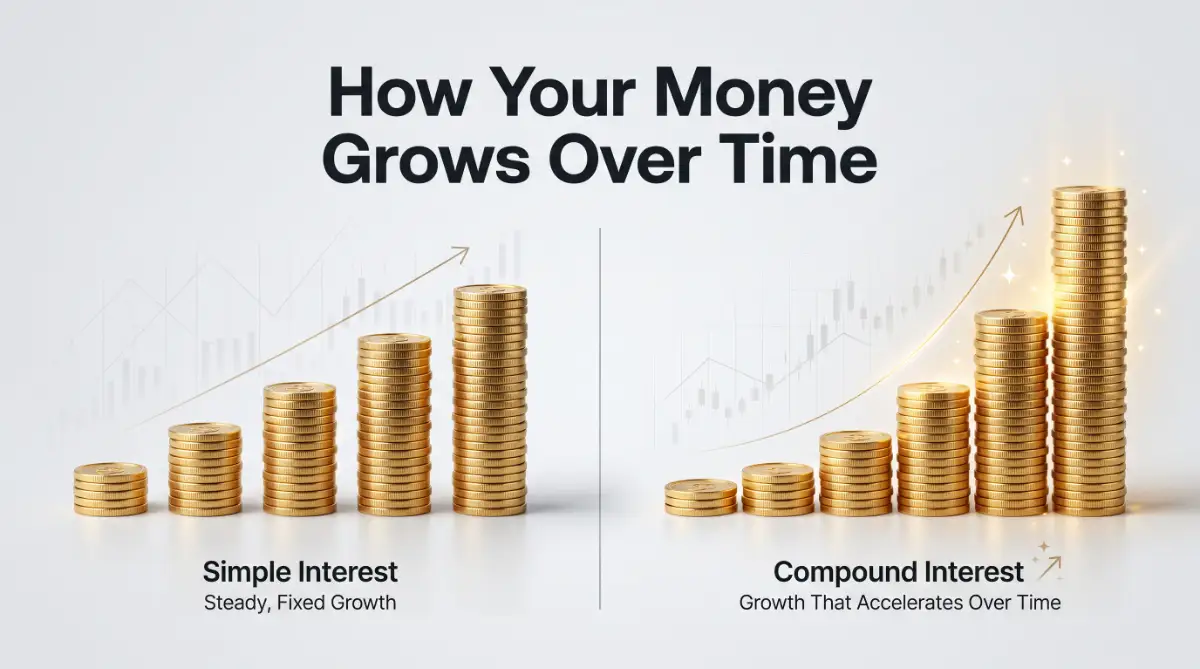
Demystifying the Numbers: What Is Simple Interest?
Let us start with the absolute basics of how money grows. Simple interest is the most basic way to calculate the cost of borrowing or the return on savings.
It is calculated only on the original amount of money you put in, which is called the principal. The money you earn does not help you earn more money in the future.
Think of it like a rental property where you collect the exact same amount of rent every single month. No matter how long you keep the property, the monthly rent check stays flat.
The Math Behind Flat Growth
To see this in action, we can use a very basic formula. The formula for simple interest is:
Interest = Principal × Rate × Time
Let us look at a real-life example to make this easy to understand. Imagine you deposit $1,000 into a savings account that pays 5% simple interest every year.
In your first year, you will earn $50 in interest. In your second year, you still earn exactly $50 because your interest is only calculated on that original $1,000.
After ten years, you will have earned $500 in total interest. Your total balance will be $1,500.
It is clean, predictable, and incredibly easy to calculate. However, as you can see, your earning power stays exactly the same every single year.
Continue Reading>>
The Snowball Effect: What Is Compound Interest?
Now, let us look at the real engine of long-term wealth. Compound interest is what happens when you earn interest on your original deposit, plus the interest you already earned.
It is literally interest earning interest. This process creates a powerful cycle where your money begins to grow faster and faster over time.
Think of it like rolling a tiny snowball down a snowy hill. As it rolls, it picks up more snow, gets bigger, and rolls even faster.
Interest on Your Interest
Let us use the exact same $1,000 example with 5% compound interest to see the difference. In your first year, you earn $50, making your total balance $1,050.
In the second year, the bank does not calculate your interest on just the original $1,000. They calculate it on your new balance of $1,050.
So, in year two, you earn $52.50 instead of $50. Your new balance becomes $1,102.50.
This might seem like a very small difference of just two dollars and fifty cents. But watch what happens as time goes on.
After ten years of compound interest, your balance grows to $1,628.89. That is almost $130 more than the simple interest account without you adding a single extra penny.
If you leave that money for thirty years, the simple interest account grows to $2,500. Meanwhile, the compound interest account shoots up to $4,321.94.
Check more below>>
If you want to see these concepts in action, watch this quick breakdown of how simple and compound interest work in real life. It makes the math easy to visualize before you look at the comparison table below.
Simple vs Compound Interest: A Side-by-Side Look
To help you visualize this better, let us compare the two side-by-side. This table shows how a single deposit of $10,000 grows at a 7% rate over different time frames.

As you can see, the gap is very small in the beginning years. But as time goes on, the compound interest line curves upward dramatically while simple interest stays completely flat.
Myth vs Reality in Personal Finance
There are many misconceptions about how interest works. Let us clear up some of the most common myths that might be holding you back.
Myth 1: You need a lot of money to start compounding
Many people believe that compound interest is only for wealthy investors with thousands of dollars. This is completely false.
Compounding works on any amount of money, even if you start with just ten dollars. The most important factor in compounding is actually not the amount of money, but time.
The earlier you start, the more time your money has to grow itself. Starting small today is much better than waiting to start big later.
Myth 2: All bank accounts compound the same way
It is easy to assume that any savings account will grow your money quickly. In reality, interest can compound daily, monthly, quarterly, or yearly.
The more frequently your interest compounds, the more money you will earn. A bank account that compounds daily will earn you more than an account that compounds yearly, even with the same interest rate.
Always check the fine print of your bank account to see how often it compounds.
How Compounding Can Work Against You: The Debt Trap
We usually talk about compound interest as a tool for building wealth. But it is important to remember that this tool has a dark side.
When you borrow money, compound interest can work against you in a very painful way. This is exactly how credit card debt spirally gets out of control for millions of people.
The Credit Card Cycle
Most credit card companies charge compound interest daily on your unpaid balance. If you only make the minimum payment, you are barely covering the interest you owe.
The remaining interest gets added to your balance, and you are charged interest on top of that interest the very next month. This is why a small purchase can end up costing you double or triple the original price over time.
If you want to protect your financial peace, you must treat high-interest debt as an emergency. Always try to pay off your credit card balances in full every single month.
Smart Money Moves You Can Make Today
Now that you understand the mechanics of growth, how can you use this knowledge in your daily life? Here are a few practical steps you can take starting today.
I made the mistake of leaving my money in a traditional bank for years because I thought all savings accounts were basically the same. Once I finally moved my emergency fund to an account that compounds daily, I started seeing small interest payments deposit into my account every single month.
It was an eye-opening moment that proved you do not need to save more money to actually make more money.
1. Look for High-Yield Savings Accounts
Traditional banks often pay close to 0.01% interest on standard savings accounts. This means your money is actually losing purchasing power to inflation every day.
Look for online banks that offer High-Yield Savings Accounts (HYSAs). These accounts often pay much higher interest rates and compound monthly or daily.
It takes less than fifteen minutes to open one online, and it instantly boosts your earning potential.
2. Start As Early As Possible
Time is the most powerful ingredient in the compounding formula. If you start saving in your twenties, you will need to save far less money to reach your financial goals than someone starting in their forties.
Do not wait for the perfect time or the perfect salary. Start with whatever small amount you can spare today and let time do the heavy lifting for you.
3. Pay Down High-Interest Loans First
If you have outstanding loans, look closely at their interest structures. Focus on paying down debts that compound frequently first.
By eliminating those compounding debts early, you save yourself from paying massive amounts of extra interest over the life of the loan.
Final Thoughts on Your Financial Journey
Understanding the difference between simple and compound interest is like finding a map in a dark forest. It changes how you look at every dollar you earn, save, and spend.
Simple interest is great for short-term loans where you want predictable costs. Compound interest is your best friend for long-term savings and building security.
Take a close look at where your money is sitting right now. Make sure you are putting yourself on the right side of the compound curve so your future self can thank you.
Advanced Strategies to Maximize Your Interest Earnings
Understanding the difference between simple and compound interest is only your first step. To truly build wealth, you must learn how to put these concepts into action like a professional.
Many successful savers do not just leave their money in a basic account and hope for the best. They actively look for ways to speed up the compounding machine.
The Magic Rule of Seventy-Two
When you start saving, you probably want to know how long it will take for your money to double. Fortunately, there is a very simple shortcut used by financial planners called the Rule of Seventy-Two.
To use this rule, you simply divide the number seventy-two by your expected annual interest rate. The result tells you approximately how many years it will take to double your cash.
For example, if you have a savings account earning a 6% compound interest rate, your money will double in about twelve years. If you can secure an 8% interest rate, your money will double in just nine years.
This simple math trick helps you quickly compare different financial options without using complex calculators. It is a fantastic way to plan out your long-term goals.
Choose Daily or Monthly Compounding Frequencies
Not all compound interest accounts are built the same way. The frequency of compounding can make a massive difference in your final balance over time.
Some accounts compound your interest only once a year, while others compound it monthly or even daily. You always want to choose the account that compounds as frequently as possible.
Imagine two different bank accounts that both offer a 5% interest rate on a ten-thousand-dollar deposit. One account compounds annually, and the other compounds daily.
After twenty years, the daily compounding account will earn you hundreds of dollars more than the annual compounding account. This happens because your daily interest earnings start making their own money almost instantly.
Harness the Power of Automatic Reinvestment
One of the biggest secrets to building long-term wealth is to make sure your earnings are never left sitting idle. If you receive an interest payout, you should never spend it immediately.
Instead, you must set up your accounts to automatically reinvest those earnings back into the principal balance. This process is often called a dividend reinvestment plan when dealing with market assets.
By doing this, you ensure that your compounding snowball never stops rolling. It is an excellent habit to build when you are working on building a bulletproof emergency fund fast to protect your family.
You can easily calculate how these different frequencies and rates will affect your specific savings goals. Feel free to use the official compound interest calculator from the SEC to test out different scenarios yourself.

Hidden Trapdoors: Where Savers Lose Their Compounding Power
It is incredibly easy to make simple mistakes that completely ruin your financial progress. Even if you understand how interest works, certain habits can quietly drain your savings.
If you are not careful, these hidden traps can keep you stuck in a cycle of living paycheck to paycheck. Let us look at the most dangerous mistakes you need to avoid today.
The Pain of Constantly Interrupting the Engine
The absolute biggest mistake people make with compound interest is interrupting it before it can work its magic. Compounding requires time, and it starts out very slowly in the early stages.
Many savers get impatient after a few years because they do not see huge results. They decide to pull their money out to buy a new car or go on an expensive vacation.
Every time you take money out of your compounding account, you reset the clock back to zero. You rob yourself of the massive growth that happens in the later decades of your plan.
Think of your savings like a fruit tree that you just planted. If you dig up the roots every few years to check on them, the tree will eventually die.
The Danger of Daily Compound Debt
As we discussed earlier, compound interest can also work against you when you owe money. This is especially true with high-interest credit cards and short-term loans.
Many people focus heavily on saving money while ignoring their outstanding debts. If you have credit card debt at an eighteen percent compound interest rate, your savings cannot keep up.
The interest you owe on your debt will grow much faster than the interest you earn on your savings. Before you focus entirely on saving, you must create a clear plan to handle what you owe.
If you are struggling with multiple balances, you can look into ways to consolidate multiple debts before the interest piles up too high. Taking this step early can stop the high-interest cycle from ruining your financial future.
Falling Into the Late Payment Trap
When you borrow money, missing your payment deadlines can cause severe financial damage. Many lenders will punish you by increasing your interest rates or compounding your outstanding fees.
This is why managing your monthly payments must always be a top priority. Missing payments can quickly drag down your credit score and make future borrowing incredibly expensive.
You need to know exactly how your lender calculates interest so you do not get caught off guard. This is especially true for loans where missed payments can trigger heavy compounding penalties.
To avoid severe financial stress, you must understand exactly what happens when you miss a personal loan payment before you take on new debt. Being proactive is the only way to protect your budget from compounding penalties.
Choosing the Wrong Loan Terms
When looking for a loan, many people only look at the monthly payment amount instead of the actual interest structure. This mistake can cost you thousands of dollars in unnecessary fees.
A simple interest loan is almost always better for a borrower than a compound interest loan. Unfortunately, many borrowers sign contracts without reading the fine print.
Before you sign any loan agreement, ask the lender exactly how the interest is calculated. If they compound the interest daily or monthly, you might want to look for a better option elsewhere.
To make sure you get the best deal possible on your next loan, it is highly recommended to understand common personal loan mistakes to avoid before talking to a bank.
You can also check out resources from the Consumer Financial Protection Bureau to learn more about your rights as a borrower. They offer free guides to help you recognize unfair loan terms.
Your Monday Morning Action Plan
You now have the exact knowledge you need to master simple and compound interest. But knowledge is only useful if you actually put it into practice.
Do not let this information sit in your mind without taking action. Here is your quick, step-by-step checklist to start making smarter money moves tomorrow morning.
- Check Your Current Accounts: Log into your bank accounts and find your current interest rates. If your savings account is paying less than one percent, it is time to move your money.
- Open a High-Yield Account: Research safe, online-only banks that offer high-yield savings options. Look for accounts that compound daily or monthly with zero monthly fees.
- Automate Your Savings: Set up a small, automatic transfer from your checking account to your savings account every single payday. Even twenty dollars a week will compound into a massive sum over time.
- Review Your Debts: Make a list of all your outstanding loans and credit cards. Put any extra money you have toward paying off the accounts with the highest compound interest rates first.
Building wealth is not about taking huge risks or finding get-rich-quick schemes. It is about making smart, consistent choices every single day.
By putting your money into accounts that use compound interest, you are setting yourself up for long-term comfort. Take your first step today, and let time build the secure financial future you deserve.
Making my very first transfer to a high-yield account felt scary at the time, but it completely changed how I look at my hard work. You do not need to understand complex math or have thousands of dollars to start making your money grow.
Take just one small action today, even if it is just moving twenty dollars, so your future self can enjoy the peace of mind you deserve.
Disclaimer
The information provided in this article is for educational and informational purposes only. It should not be considered professional financial advice.
Always consult with a certified financial planner or a licensed accountant before making any major financial decisions.


